 Phil's Blog
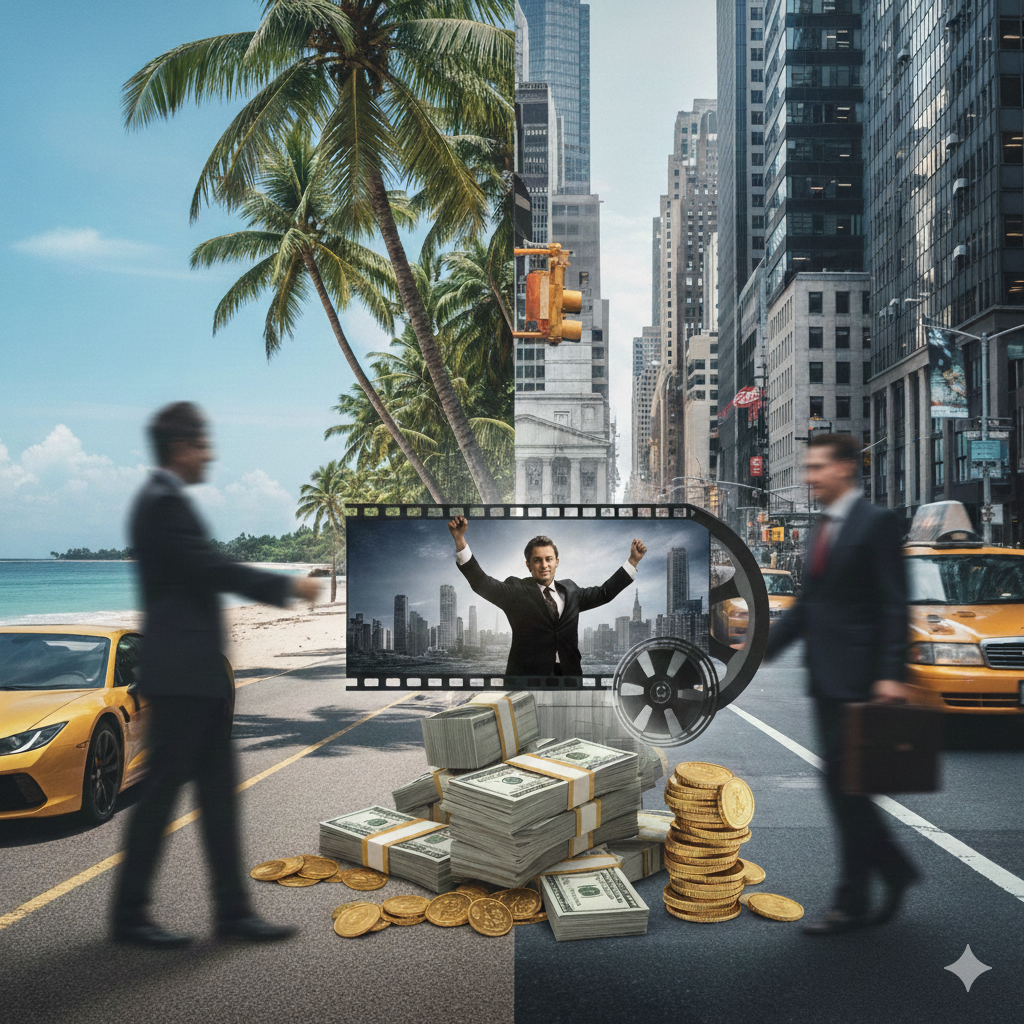
It remains one of the most surreal moments in the history of Hollywood. On a glittering night in January 2014, Leonardo DiCaprio ascended the stage at the Golden Globe Awards to accept the trophy for Best Actor. In his acceptance speech, casually sandwiched between thanks to his director and his parents, he offered gratitude to three men: Joey, Riz, and Jho. He thanked them for their unwavering commitment to the film, for taking a risk on a movie about financial excess that traditional studios were too afraid to touch.
The audience applauded, unaware of the profound irony unfolding before them. The film was The Wolf of Wall Street, a biopic about a fraudster who fleeced investors to fund a life of debauchery. And "Jho" was Low Taek Jho, a Malaysian financier who was at that very moment orchestrating a real-life financial heist so massive it would make the crimes of Jordan Belfort look like petty shoplifting. The money fueling the production of the movie didn't come from box office receipts or venture capital. It came from the sovereign treasury of the Malaysian people.
The 1MDB scandal is not merely a story of corruption. It is the defining financial crime of the 21st century. It is a saga that exposes the dark plumbing of the global financial system, where a sovereign wealth fund designed to lift a nation out of poverty was instead hollowed out to buy superyachts, Monet paintings, diamond jewelry, and the very movie that warned the world about the dangers of greed.
The Architect of Illusion
To understand the theft, one must understand the thief. Jho Low was not a banker, nor was he a politician. He was a master of perception. Born to a wealthy but not ultra-rich family in Penang, Low attended Harrow School in London and later the Wharton School at the University of Pennsylvania. It was here that he cultivated the social capital that would become his primary currency. He befriended the children of Middle Eastern royalty and Southeast Asian political elites, learning early that in the world of high finance, who you appeared to know was often more important than what you actually owned.
Low’s most consequential friendship was with Riza Aziz, the stepson of Najib Razak, a rising political star in Malaysia who would soon become Prime Minister. When Najib assumed power in 2009, he sought to create a sovereign wealth fund that would spur economic development and turn Kuala Lumpur into a global financial hub. He named it 1Malaysia Development Berhad, or 1MDB.
On paper, 1MDB was a state-owned strategic development company. In reality, it was a vehicle with a fatal flaw. Its governance structure gave the Prime Minister sole authority to approve investments, and Jho Low, despite holding no official position, acted as its shadow operator. Low was the puppet master. He leveraged his connections with Najib to direct the billions inside the fund while remaining completely off the books.
The PetroSaudi Heist
The looting began almost immediately. In 2009, months after its inception, 1MDB entered into a joint venture with PetroSaudi International, a private Saudi oil extraction company. The deal was ostensibly to invest in energy projects. 1MDB put up one billion dollars in cash.
However, the deal was a mirage. Through a labyrinth of bank transfers, 700 million dollars of that initial investment was diverted away from the joint venture and into a Swiss bank account controlled by a shell company called Good Star Limited. The name sounded corporate and innocuous, but Good Star had a single beneficial owner: Jho Low.
In a single stroke, nearly three-quarters of a billion dollars of Malaysian public money vanished. It was a heist of breathtaking simplicity hidden behind the complexity of cross-border wire transfers. When banks questioned the transaction, officials at 1MDB claimed Good Star was a subsidiary of PetroSaudi. It was a lie, but it was a lie stamped with the authority of a sovereign government, and the money flowed.
The Goldman Sachs Era
If the PetroSaudi deal was the opening act, the bond sales were the main event. By 2012, 1MDB needed more capital. Jho Low turned to Goldman Sachs, the Wall Street titan, to bring credibility to the fund. Over the next year, Goldman Sachs raised 6.5 billion dollars for 1MDB through three separate bond offerings.
The fees Goldman charged were astronomical at nearly 600 million dollars. This was roughly two hundred million more than the standard rate for such transactions. But 1MDB didn't blink. The goal was speed and volume, not value. The prospectus for these bonds claimed the money would be used to build power plants and develop the Tun Razak Exchange, a new financial district in Kuala Lumpur.
While some of the money did go towards purchasing power assets, billions were siphoned off. This phase of the fraud introduced a new level of sophistication known as the "Fake Aabar" trick. Aabar Investments PJS was a legitimate arm of the Abu Dhabi sovereign wealth fund, IPIC. Jho Low and his accomplices incorporated a shell company in the British Virgin Islands called "Aabar Investments PJS Limited." It had almost the exact same name, but it was a hollow shell owned by Low and officials he had bribed.
When 1MDB transferred over a billion dollars to "Aabar" as a security deposit, they weren't sending it to Abu Dhabi. They were sending it to the BVI shell company. From there, the money flowed into the global financial system, effectively laundered. It was a billion-dollar phishing scam executed at the highest level of state finance.
Champagne and Shadows
What does one do with stolen billions? Jho Low spent with a ferocity that stunned even the jaded elite of New York and Las Vegas. The spending was not just about luxury. It was about buying legitimacy. He threw parties that became legendary, flying in celebrities like Jamie Foxx and Britney Spears to perform for private birthdays. He gambled millions in single nights at the Venetian in Las Vegas.
He became a collector of trophies. He purchased a 250 million dollar superyacht named the Equanimity, which featured a gym, a massage room, and a sauna. He bought a penthouse at the Time Warner Center in Manhattan. He bought Basquiat and Monet paintings. He even bought the transparent acrylic grand piano used in the movie Casablanca.
But his most audacious purchase was influence in Hollywood. Riza Aziz, using funds traced back to the 1MDB theft, co-founded Red Granite Pictures. The breakout hit for the company was The Wolf of Wall Street. The production budget, the lavish launch parties in Cannes, the Marlon Brando Oscar statuette gifted to DiCaprio were all paid for with money stolen from the Malaysian people. The irony was perfect. A movie condemning financial excess was the product of the very crime it depicted.
The House of Cards Collapses
The unraveling of 1MDB was not instantaneous. It was a slow burn ignited by a few brave journalists and a whistleblower. Clare Rewcastle Brown, a British journalist running the blog Sarawak Report, began receiving leaked emails detailing the PetroSaudi deal. The emails clearly showed Jho Low directing the flow of funds to Good Star Limited.
Simultaneously, the Wall Street Journal launched an investigation that would deliver the death blow. In July 2015, they published a report tracing nearly 700 million dollars from 1MDB directly into the personal bank accounts of Prime Minister Najib Razak. The headline sent shockwaves through Malaysia. Najib claimed the money was a "donation" from a Saudi prince, a defense that was widely ridiculed but politically enforced at home. He fired his Attorney General, purged his cabinet of dissenters, and cracked down on the media.
But while Najib could control the narrative inside Malaysia, he could not control the global financial system. The scale of the money laundering had triggered alarms in Switzerland, Singapore, and most importantly, the United States.
The DOJ Strikes
In 2016, the United States Department of Justice announced its largest-ever kleptocracy asset forfeiture lawsuit. They sought to seize more than one billion dollars in assets tied to 1MDB. The DOJ complaint was a damning document, laying out the timeline of the fraud in excruciating detail. It did not name Najib Razak explicitly, referring to him instead as "Malaysian Official 1," but the identity was unmistakable.
The DOJ seizure list read like a catalogue of absurd wealth: higher-end real estate in Beverly Hills, the Equanimity yacht, the rights to The Wolf of Wall Street, and millions in jewelry gifted to Australian model Miranda Kerr and the wife of "Malaysian Official 1." The veil was lifted. The world could now see that 1MDB was not a development fund. It was a global credit card for a small cabal of thieves.
The Fall of a Dynasty
The scandal proved to be the undoing of the sprawling political dynasty of Najib Razak. In the 2018 Malaysian general election, a 92-year-old Mahathir Mohamad came out of retirement to lead the opposition. Fueled by public outrage over the 1MDB theft and the soaring cost of living, the opposition coalition achieved the unthinkable. They defeated the ruling coalition that had held power since Malaysia’s independence in 1957.
Days after the election, police raided the properties of Najib. The visuals were cemented in the national psyche: shopping carts filled with hundreds of Hermes Birkin bags, millions in cash stuffed into suitcases, and tiaras and necklaces worth fortunes. Najib was arrested, charged, and eventually convicted of corruption. He was sentenced to twelve years in prison, becoming the first Malaysian Prime Minister to be jailed.
Goldman Sachs paid a heavy price as well. The bank ultimately agreed to pay billions in fines to regulators around the world and clawed back executive pay, admitting that its oversight had failed catastrophically.
The Ghost in the System
And what of Jho Low? The architect of the illusion remains a ghost. He is believed to be hiding in China, moving between cities to evade Interpol notices. He has consistently denied wrongdoing, claiming he was merely an advisor and a victim of political crossfire. Despite his fugitive status, he reportedly retains access to significant wealth, a testament to the dark corners of the financial system that still allow illicit capital to hide.
The legacy of 1MDB is a scar on the face of global finance. It shattered the myth that sovereign wealth funds are inherently safe or benevolent. It exposed the complicity of major Western financial institutions, law firms, and real estate agents who were all too willing to look the other way as long as the wires cleared. It proved that in the digital age, it is possible to steal a billion dollars without ever holding a gun, provided you know the right passwords and own the right friends.
Ultimately, the story of 1MDB is a tragedy. The 4.5 billion dollars estimated to have been stolen could have built hospitals, schools, and infrastructure for Malaysia. Instead, it built a mirage of wealth for a handful of men who flew too close to the sun, fueled by the belief that the party would never end. But as the credits roll on the real-life drama of 1MDB, the audience is left with a sobering realization. The Wolf of Wall Street was playing with Monopoly money compared to the Wolf of Kuala Lumpur.