 Phil's Blog
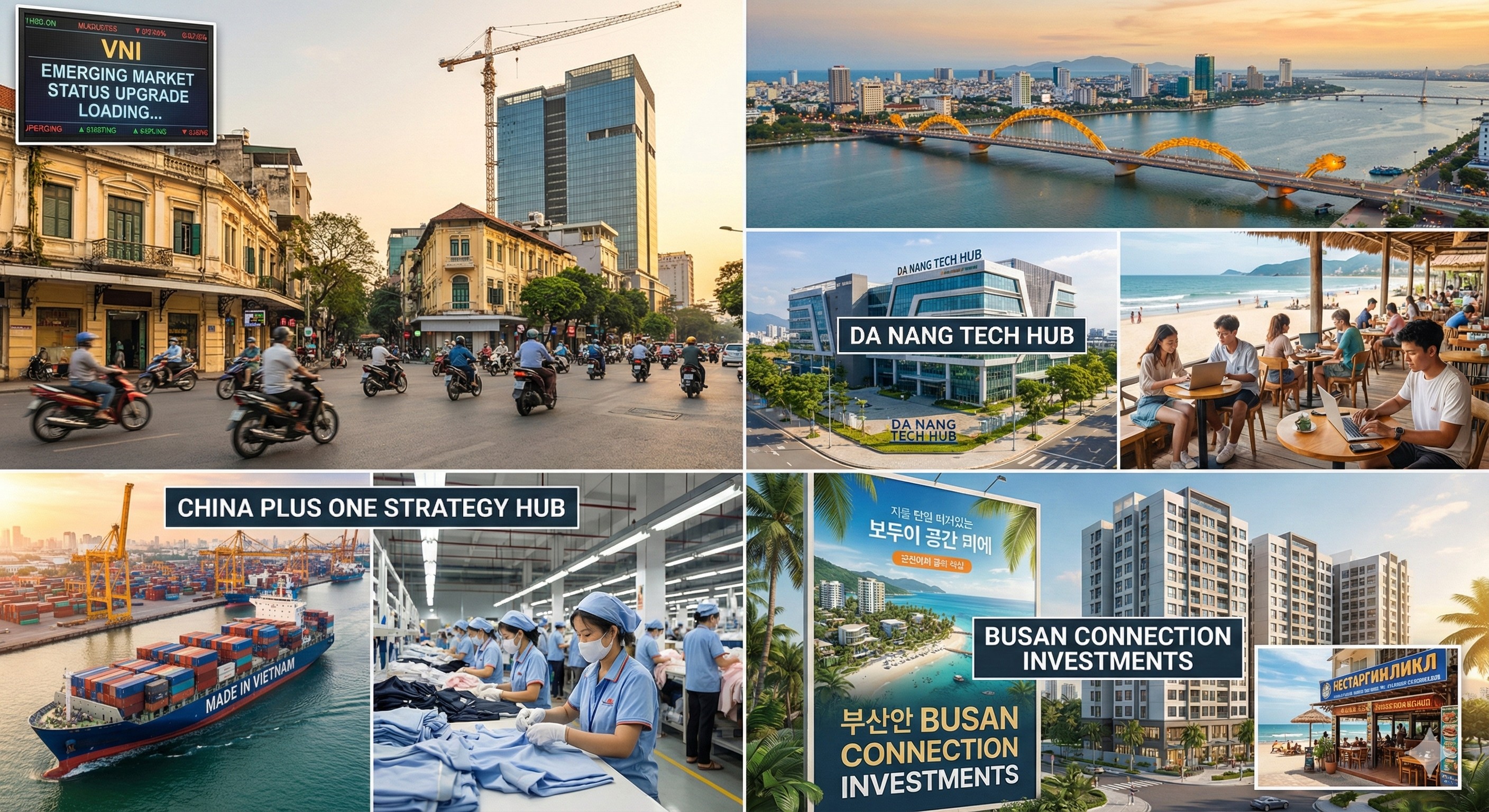
Stand on the corner of a busy intersection in District 1 of Ho Chi Minh City or the Old Quarter of Hanoi in late 2025, and the sensory overload tells a story that GDP figures can only hint at. The roar of motorbikes is still there, a chaotic river of steel and determination, but the air has changed. Among the exhaust fumes of Honda Cubs, you now catch the hum of VinFast electric scooters and the silent glide of made-in-Vietnam electric buses. Above the colonial-era shophouses, glass towers housing fintech startups and semiconductor design firms pierce the smog. This is a country in the throes of a violent, beautiful metamorphosis. The "Vietnamese Dragon" is no longer a sleeper story for adventurous backpackers or niche frontier investors; it has woken up, stretched its wings, and is demanding a seat at the high table of the global economy. As the year 2025 draws to a close, Vietnam finds itself graduating from a low-cost manufacturing outpost into a complex, capital-rich economy, navigating a path laden with high-stakes opportunities and structural paradoxes that define its new era.[1]
The Financial Awakening
The most definitive signal of this arrival came on October 8, 2025, a date that will likely be circled in financial history books for decades. After seven years of rigorous regulatory stress-testing and diplomatic maneuvering, FTSE Russell officially announced the reclassification of Vietnam from a Frontier Market to a Secondary Emerging Market. To the layperson, this might sound like bureaucratic jargon, but in the plumbing of global finance, it is akin to a dam breaking. When the reclassification becomes effective in September 2026, it will trigger a mechanical, automatic flood of billions of dollars in "passive" capital - money from pension funds and ETFs worldwide that track emerging market indices. These funds do not choose to invest in Vietnam; they are mandated to. This liquidity injection is poised to lower the cost of capital for Vietnamese conglomerates, allowing them to fund the next generation of infrastructure without begging for bilateral aid. The government, emboldened by this victory, is not resting on its laurels. It has already set its sights on an even more prestigious upgrade from MSCI by 2027, aiming to cement its status as a premier investment destination in Southeast Asia alongside giants like Indonesia and Thailand.[2]
The Geopolitical Dance
However, the road to economic maturity is rarely a straight line, and Vietnam’s ascent is complicated by a delicate geopolitical dance, particularly with the United States. In August 2025, a wave of disappointment washed over Hanoi when the U.S. Department of Commerce ruled to retain Vietnam’s status as a "Non-Market Economy" (NME). Despite Vietnam’s arguments that its currency is convertible and its labor market free, Washington held firm, a decision driven as much by domestic American protectionism as by economic metrics. This status is a thorn in the side of the country’s export engine. It allows the U.S. to use third-country data - often from nations with higher production costs - to calculate anti-dumping duties on Vietnamese goods. For a shrimp farmer in the Mekong Delta or a steel producer in Ba Ria-Vung Tau, this means their products can be slapped with punitive tariffs that have little to do with their actual production costs. Yet, even with this handicap, Vietnam’s trade surplus with the U.S. continues to balloon, driven by a relentless shift in global supply chains that has seen the country become the primary beneficiary of the "China Plus One" strategy.[4]
The manufacturing story itself has evolved beyond the simple narrative of cheap labor. For years, companies moved to Vietnam because wages were half those of China. But in 2025, the conversation has shifted from "Vietnam Cheap" to "Vietnam Prime." The foreign direct investment flowing into the country is no longer just building sneaker factories; it is building the nervous system of the digital age. The government has launched an aggressive semiconductor diplomacy campaign, aiming to train 50,000 engineers by 2030 to staff the fabrication plants and design centers springing up in the north and central regions. High-tech exports now dominate the trade balance, pushing aside the traditional stalwarts of textiles and footwear.
The New Economic Geography: A Triad of Power
If you are looking at a map of Vietnam printed before July 2025, throw it away. It is obsolete. On July 1, 2025, the Vietnamese government enacted one of the most ambitious administrative consolidations in its modern history, effectively erasing provincial borders to create integrated "Mega-Economic Zones." This was not merely a bureaucratic paper-shuffling; it was a strategic move to smash the bottlenecks of land availability and disjointed planning that had begun to choke growth. For an investor conducting a location analysis today, the country is no longer a collection of 63 provinces, but a triad of consolidated power centers: the Northern Fortress, the Southern Behemoth, and the Central Pivot.
### The Northern Fortress: The Electronics Artery
In the North, the industrial port city of Hai Phong was merged administratively with its neighbor Hai Duong. This union has created a seamless logistics-manufacturing corridor that stretches from the deep-water Lach Huyen Port directly to the factory gates of the electronics giants. For investors, this region remains the undisputed king of high-tech hardware. It is here that the "China Plus One" strategy is most physically visible. The logic is geographical; the North is the terminus of the new standard-gauge railway lines running from Yunnan and Guangxi. This rail connectivity solves the historical "break of gauge" problem, allowing trainloads of components from Shenzhen to roll directly into Vietnamese assembly lines without offloading at the border.[18]
However, entry into this fortress comes at a premium. Industrial land occupancy in this northern cluster is running hot at approximately 83%, driving land lease prices to an average of $145 per square meter per term. While this is rising, it remains competitive compared to the South. The value proposition here is ecosystem depth; if you need to be within a two-hour truck drive of a Samsung or Foxconn supplier, you pay the price to be in the North.
### The Southern Behemoth: The Service & Logistics Super-Region
The most dramatic change on the map is the expansion of Ho Chi Minh City. As of July 2025, the commercial capital has formally incorporated the industrial powerhouses of Binh Duong and the port province of Ba Ria-Vung Tau into a single administrative planning unit, the "Greater HCMC Zone." This merger was born of necessity; the old Ho Chi Minh City had literally run out of space. By absorbing Binh Duong’s industrial parks and Vung Tau’s port complex, the city has integrated the entire supply chain - from factory floor to container terminal - under one roof.
For the investor, the South remains the most expensive option, with industrial land prices hitting $200 per square meter per term and occupancy rates nearing a suffocating 92%. But you get what you pay for. This region offers the deepest talent pool for management and services, the most sophisticated consumer market, and unrivaled global maritime connectivity via the Cai Mep-Thi Vai port complex. It is the location of choice for high-value manufacturing that requires air freight, complex logistics, or immediate access to the domestic consumer class.
### The Central Pivot: The Cost-Efficiency Sweet Spot
While the North and South wrestle with congestion and rising costs, the Central region - anchored by the newly merged entity of Da Nang and Quang Nam - has emerged as the "Goldilocks" zone. This area is no longer just a tourism strip; it is Vietnam’s answer to cost inflation. With the North and South becoming increasingly expensive, the Center offers a powerful arbitrage opportunity. Industrial factory rentals here hover around $5 per square meter per month, significantly undercutting the two main poles.
This region is positioning itself differently. It is not trying to be the heavy manufacturing hub of the North or the commercial giant of the South. Instead, it is the "Silicon Coast" and a hub for lighter, high-tech industries that value livability and lower overheads. The Da Nang-Quang Nam merger combines Da Nang’s airport and tech infrastructure with Quang Nam’s ample land bank, offering investors the ability to house headquarters in a smart city while placing production facilities just thirty minutes away on affordable land.[8]
### Connecting the Dots: The Iron Spine
Binding these three regions together is an infrastructure network that has finally moved from blueprints to asphalt. By the end of 2025, the country hit the psychological milestone of 3,000 kilometers of completed expressways. The North-South Expressway is now a functional reality, drastically cutting logistics costs and travel times. A truck can now drive from the Chinese border to the Mekong Delta on a continuous high-speed artery.
Simultaneously, the commitment to the North-South High-Speed Railway - a "moonshot" project valued at over $67 billion - promises to connect Hanoi and Ho Chi Minh City in just over five hours by 2035 at speeds of 350 km/h. This rail line is intended to unify the country’s fragmented economic geography. Simultaneously, new standard-gauge rail links are being pushed from Hai Phong port to the Chinese border. These lines are critical for the Belt and Road Initiative (BRI), resolving the historical "break of gauge" issue that forced trains to stop at the border to transfer cargo. By integrating its rail network directly with China’s, Vietnam is physically cementing its role as the downstream partner in the global electronics supply chain, ensuring that components from Shenzhen can flow seamlessly to assembly lines in Bac Ninh and Hai Phong.[17]
Green Gold: The Agricultural Counterweight
While the neon lights of the cities and the hum of high-tech factories grab the headlines, a quieter but equally potent revolution is taking place in the red basalt soil of the Central Highlands. To truly understand Vietnam’s economic resilience, one must look beyond the microchip to the coffee bean and the cashew nut. Vietnam has quietly engineered a global monopoly in specific agricultural niches that provides a critical counterweight to the volatility of tech manufacturing. This is the story of "Green Gold."
By late 2025, Vietnam has cemented its position not just as a grower, but as the world's processing factory for key commodities. Consider the cashew nut. It is a little-known fact that Vietnam is the geopolitical center of gravity for the global cashew trade. The country does not just export what it grows; it imports massive quantities of raw nuts from Africa and Cambodia, leveraging its superior processing technology and labor efficiency to shell, roast, and package them for the world. In 2025, despite global supply chain hiccups, Vietnam retained its crown as the world's number one cashew exporter, an industry that generates billions of dollars and employs hundreds of thousands of people in provinces like Binh Phuoc. This value-added approach - importing raw materials to export finished goods - mirrors the strategy used in electronics, proving that the Vietnamese industrial model is replicable across sectors.
Then there is coffee. The world knows Vietnam runs on caffeine, but the scale of its dominance is staggering. As the second-largest coffee producer globally and the undisputed king of Robusta, Vietnam effectively sets the price for your morning instant coffee. In 2025, exports are projected to shatter the $8 billion mark, driven by high global prices for Robusta beans and a modernized processing industry that captures more value within the country's borders. But the real story is the internal shift in culture. The younger generation is no longer just exporting raw green beans; they are building domestic brands and high-end chains that rival Starbucks. Walk through the streets of Da Nang or Ho Chi Minh City, and you see a cafe culture that is vibrant, distinct, and increasingly lucrative. This domestic consumption acts as a buffer, ensuring that the industry is not solely dependent on the whims of global commodity markets.[7]
The Innovation Hub: Da Nang's Digital Soul
Nowhere is this new economic identity more visible than in the central city of Da Nang. If Hanoi is the political brain and Ho Chi Minh City is the commercial heart, Da Nang has emerged as the country’s innovative soul - a "Third Pole" of growth that offers a starkly different vision of the future. The city has moved aggressively to position itself as the "Silicon Coast" of Southeast Asia. Bypassing the gridlock of national bureaucracy, Da Nang successfully lobbied for the creation of a pilot Free Trade Zone (FTZ) under Resolution 136. This zone is a regulatory sandbox where the normal rules do not apply. Investors here enjoy a corporate income tax rate of just 10% for fifteen years, along with complete tax holidays for the first four years of operation and duty-free movement of goods. It is a proposition designed to be irresistible to global tech giants, and it is working.
The flagship of this tech ambition is the FPT Corporation, which recently inaugurated a massive Semiconductor R&D Center in the city. The goal is audacious: by 2030, Da Nang aims for the digital economy to contribute nearly 40% of its gross regional product. This agricultural prowess dovetails with a burgeoning startup ecosystem that is trying to prove Vietnam can invent, not just assemble. While Ho Chi Minh City has traditionally been the startup hub, Da Nang is carving out a niche as the incubator for "deep tech" and lifestyle startups. The city recently entered the global top 1000 startup ecosystems for the first time, driven by companies like Selly and Dat Bike that are solving specifically Vietnamese problems with home-grown technology.[9]
But it is not just domestic giants driving this shift. Walk down Pham Van Dong Street in the Son Tra district, and you might momentarily think you have been transported to Busan or Incheon. This area, known colloquially as "Little Busan," is the epicenter of a massive South Korean investment wave. Korean investors have poured billions into the city, not just in factories but in the very fabric of urban life. Companies like Hyosung are investing hundreds of millions into industrial infrastructure, while Korean tourists - over a million in 2025 alone - flood the hotels and golf courses. The cultural affinity is palpable; Korean BBQ restaurants sit comfortably alongside Vietnamese noodle shops, and Korean executives find it easier to relocate their families here than perhaps anywhere else in Southeast Asia, drawn by the familiarity and the high quality of life.[10]
This quality of life has also turned Da Nang into a magnet for a new breed of economic actor: the digital nomad. While the concept of remote work has normalized globally, Da Nang has perfected the ecosystem to support it. The An Thuong neighborhood has evolved into a verified campus for the laptop class, where coworking spaces like Seaview and ACE offer enterprise-grade fiber optic internet and ergonomic setups overlooking the ocean. The economic arbitrage is staggering. A remote worker earning a Western salary can live a life of luxury here, renting a modern beachside apartment for $400 to $600 a month, sipping $1.50 lattes, and eating world-class street food for pennies. This influx of human capital is creating a vibrant startup scene, as nomadic coders and designers collide with local Vietnamese talent, fostering a cross-pollination of ideas that is beginning to bear fruit in local tech ventures.[6]
Tourism, too, has evolved from a simple sun-and-sand proposition into a sophisticated economic engine. Da Nang has mastered the art of the spectacle to drive revenue. The Golden Bridge, held aloft by two giant stone hands in the Ba Na Hills, has become one of the most recognizable images of modern Vietnam, drawing millions of visitors who might otherwise have skipped the central region. But the city doesn't rest on static monuments. The Da Nang International Fireworks Festival is a month-long competition that lights up the Han River, turning the entire city into a stage. During these weeks, hotels are fully booked, restaurants overflow, and the local economy receives a massive injection of cash. Even the Dragon Bridge, which spans the river in the city center, puts on a show every weekend, breathing actual fire and water to the delight of crowds. These are not just gimmicks; they are calculated investments in "destination marketing" that keep property prices in Da Nang robust even when the broader market wobbles.
The Human Element: Culture and Crisis
However, any investor looking to tap into this potential must navigate the complex "soft software" of the Vietnamese workforce. The cliché of the hardworking Vietnamese is largely true; the streets are filled with people hustling from dawn until dusk, a legacy of a nation that is hungry to make up for lost time. Yet, the modern boardroom reveals more nuanced cultural dynamics. Foreign managers often encounter the concept of "saving face," a deep-seated cultural trait where preserving dignity and social standing can sometimes take precedence over direct efficiency. A project might be delayed not because of a lack of skill, but because a team member was hesitant to admit a mistake publicly. The younger generation, born after the Doi Moi reforms of 1986, is bridging this gap. They are active learners, often fluent in English and increasingly direct in their communication, yet they still operate within a social framework that values harmony and hierarchy. Understanding this - knowing when to push and when to respect the "face" - is often the difference between a successful venture and a frustrated exit.[19]
Contrast this nuanced optimism with the brooding crisis in the capital, Hanoi. While the financial markets celebrate, the streets of Hanoi are witnessing a brutal decoupling of asset prices from reality. The city is in the grip of a severe real estate bubble that threatens to fracture the social contract. In late 2025, the average price for an apartment in the capital surged to approximately $3,075 per square meter, an eye-watering 88% increase since 2019. To put this in perspective, while top-tier banking salaries have doubled over the last decade to around $2,200 a month, housing prices have tripled. The average Hanoian now faces the grim mathematical reality that they would need to save 100% of their income for over twenty years just to afford a mid-range home. This affordability crisis is fueling a sense of resignation among Generation Z, many of whom are opting to "lie flat" rather than engage in a rat race they feel they have already lost. The root of the problem lies in a policy paradox: local authorities rely heavily on land use fees to fund their budgets, incentivizing them to keep land valuations high, even as the central government issues directives to lower housing costs.[14]
Yet, investment opportunities persist for those who know where to look. While Hanoi overheats, the real estate market in Da Nang and its surrounding areas presents a more sustainable trajectory. The market here is driven less by pure speculation and more by the tangible demand of the tech workers, expats, and northern migrants fleeing the capital’s pollution and prices. The yields are compressing, but the fundamentals - driven by the FTZ and the tech boom - remain robust. It is a market that rewards patience and a long-term view, aligning with the city’s own master plan for 2030.
Further south along the coast, another unique demographic phenomenon plays out in the cities of Nha Trang and Cam Ranh. Despite the geopolitical isolation of Russia following the events of the 2020s, this stretch of the Vietnamese coast remains a steadfast sanctuary for Russian citizens. The Cam Ranh International Airport continues to welcome charter flights and direct connections from Russia, bringing thousands of long-stay visitors who have turned parts of Nha Trang into a "Little Russia." Here, Cyrillic signage is as common as Vietnamese, and Russian-owned businesses create a self-sustaining ecosystem that allows visitors to navigate daily life without speaking a word of English or Vietnamese. This resilience is a testament to Vietnam’s "Bamboo Diplomacy" - the ability to maintain deep, historic ties with old friends like Moscow while simultaneously courting new strategic partnerships with Washington and Seoul.[16]
Conclusion: The Tiger's Leap
For the global investor, Vietnam in late 2025 offers a compelling, if complex, thesis. It is a country that has successfully navigated the treacherous waters of the middle-income trap to emerge as a diverse, resilient economy. It is the "Next Tiger," not because it is following the exact path of South Korea or Taiwan, but because it is forging a new model that blends state-directed infrastructure growth with hyper-capitalist special economic zones. Whether it is the passive flows into the stock market, the venture capital chasing Da Nang startups, or the FDI building the next semiconductor fab, the money is voting with its feet. The risks - from the Hanoi property bubble to the whims of US trade policy - are real, but the momentum of the Dragon’s ascent feels unstoppable.
Looking toward 2030, the trajectory is clear. The government is racing to upgrade the country's physical hardware to match its economic ambitions. The North-South High-Speed Rail is the spine of this vision, but the nerves are the digital cables landing in Da Nang and the trade agreements being signed in Hanoi. The country is betting that it can transition from a "factory of the world" to a "hub of the world" - a place where goods are not just made, but designed, processed, and traded. The risks are substantial, from the overheated property market in the capital to the environmental strain of rapid industrialization. But the energy on the ground is undeniable. It is an energy fueled by a young population that believes, with ample evidence, that tomorrow will be richer than today. For the global investor, the window to enter as an early adopter has closed, but the door to participate in a maturing, complex, and highly rewarding economy is wide open. The Dragon has ascended; now it is learning to fly.
References
- Vietnam Reclassified to Emerging Market Status by FTSE Russell
- FTSE Russell announces results of September 2025 semi-annual country classification review for equities and fixed income | LSEG
- Vietnam stock market ends 2025 at historic peak, enters new growth phase - VietNamNet
- U.S. Chooses to Retain Vietnam's Non-Market Economy Status Despite Reforms
- Vietnam: Economic success threatened by Trump 2.0?
- The Ultimate Da Nang Digital Nomad Guide (Vietnam) - Bucketlist Bri
- Vietnam's coffee exports in 2025: Breaking records, targeting $8 billion
- Vietnam: Da Nang FTZ takes off — a bold step toward economic expansion
- FPT partners with Da Nang to enhance Semiconductor and Artificial Intelligence Development
- "Meet South Korea in Da Nang" opens up new cooperation opportunities - DANANG NEWS
- CN Palace Boutique Hotel & Spa - Agoda.com
- Vietnam's Beat: Where Every Digital Nomad Finds Their Seat | Vietcetera
- Da Nang: The Complete Guide for Digital Nomads in 2025
- Vietnam housing market outlook 2025–26 | Capital.com
- Hanoi housing prices outpace banker salaries, widening affordability gap - VietNamNet
- Hanoi's land revenue surge fuels housing crisis - VietNamNet
- The Russians are coming - New world order in Nha Trang, Vietnam (2025)
- Driving Growth: Business Opportunities in Vietnam's North-South High-Speed Railway Project
- "Why is Vietnam still so poor while Vietnamese work so hard?" (from Jason on Quora)