 Phil's Blog
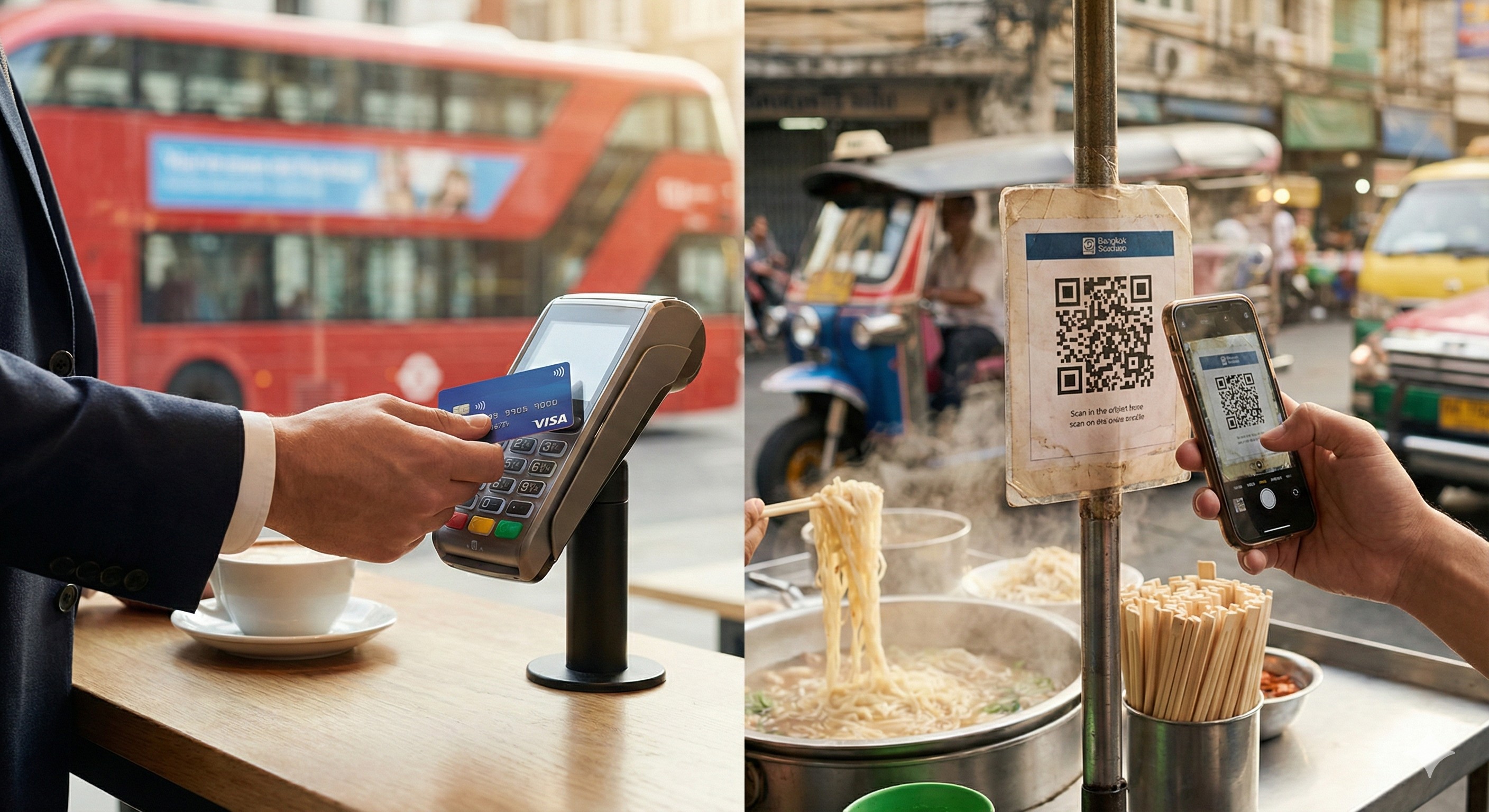
By the time you finish your Melange in a Vienna coffee house, you have participated in a financial ritual that hasn't fundamentally changed in forty years.
You signal the waiter. He brings a leather folder. You produce a plastic rectangle - perhaps a Visa or a Mastercard - and tap it against a machine. A signal travels over telephone lines or cellular networks to a server in Frankfurt or London, asking permission to move your money. It is a system built on stability, standardized hardware, and a "pull" mechanic where you hand over your keys and authorize the merchant to take what they are owed. It feels modern because it is contactless, but beneath the surface, it is a digital veneer over banking infrastructure designed when fax machines were cutting-edge technology.[2]
Now, imagine stepping off a plane in Bangkok, Shanghai, or Jakarta. You are thirsty. You walk up to a street vendor selling iced tea from a cart. There is no card machine. There is no electricity. There is only a piece of paper taped to the side of the cart, displaying a pixelated square. A local customer steps up, points their phone at the paper, types nothing, and walks away with their drink in under three seconds. You try to tap your card, but there is nothing to tap. You try to open your banking app, but it doesn't speak the language of that paper square.
You have just crossed the invisible line of the Great Payment Divide. While Europe spent decades refining the credit card network, Asia executed a technological leapfrog, bypassing expensive terminals entirely to build a new financial internet based on "push" payments, Super Apps, and the humble QR code. For the traveler in 2025, this creates a jarring disconnect. You are a digital native at home, yet you find yourself standing in a noodle shop in Chiang Mai, staring blankly at a laminated sticker, wondering why your Apple Pay is useless. This is the story of that divide, the hidden architecture that separates East from West, and the survival guide for navigating the fragmented, fascinating world of Asian finance.
The Engine Room: Why "Tap" and "Scan" Are Different Languages
To understand why you cannot simply tap your card at a Thai street stall, you have to look under the hood of the global banking system. The difference isn't just about the device in your hand; it is about the language the money speaks.
In the West, our system is built on a "pull" mechanic. When you hand your card to a waiter in Vienna, you are effectively handing over a key to your bank account. You are authorizing the merchant to "pull" funds from your ledger. The message sent from the card terminal to the bank typically uses a protocol called ISO 8583. Think of this protocol like a telegram from the 1980s. It is short, rigid, and contains very little data - just the card number, expiry, and the amount. Because this data is so sparse, the system has to separate "authorization" from "settlement." The machine says "Approved" instantly, but the merchant doesn't actually get the money until days later when the banks settle their batch files. This delay makes the system expensive and risky for small merchants, which is why your local bakery might still have a "Card Minimum" sign.[4]
In Asia, the model is flipped. Systems like Thailand's PromptPay, Singapore's PayNow, or the Chinese giants Alipay and WeChat Pay utilize a "push" mechanic. You do not hand over your key. Instead, you open your banking app, scan the merchant's address, and push the money to them. These systems largely run on a modern messaging standard called ISO 20022. If the Western card system is a telegram, ISO 20022 is a rich HTML email. It can carry massive amounts of data - invoice numbers, tax IDs, loyalty points, and messages - in a single ping. The result is that clearing and settlement happen simultaneously. The street vendor in Bangkok receives the money in their account before you have even put your phone back in your pocket. It is faster, cheaper, and requires zero hardware other than a printed sticker. This is why the grandmother selling vegetables in a rural village can accept digital payments while a café in Europe might still demand cash. She didn't need to buy a five hundred euro terminal; she just needed a printer.
China: The Super-Switch and the Dance of the Scanners
China represents the deep end of the pool. It is a market where the "App" has eaten the "Bank." The duopoly of Alipay and WeChat Pay handles more transactions daily than Visa and Mastercard combined globally. But for the foreigner, the learning curve is steep, and it usually starts with the confusion of the "Mexican Standoff" at the register where you hold your phone, they hold a scanner, and nobody knows who moves first.
Practical Guide: The Two Modes of Scanning
For the traveler, the technical distinction between "Consumer Presented" and "Merchant Presented" is vital.
| Mode | Technical Name | Who Generates the Code? | How it Works |
|---|---|---|---|
| Merchant Presented (MPM) | Static QR | The Merchant | The QR code is a static string containing the Merchant's ID. The user's phone reads it, connects to the server (Alipay/WeChat), and "Pushes" the funds. Used by street vendors and taxis. |
| Consumer Presented (CPM) | Dynamic Token | The User | The user's phone generates a one-time token (a barcode/QR) that changes every 60 seconds. The merchant's laser scanner reads this token and "Pulls" the funds. Used by Lawson, FamilyMart, and Metro gates. |
Pro Tip: If you are at a Lawson or 7-Eleven, do not try to scan anything. Just hold out your "Payment Code" screen. The laser gun does the rest.
Behind the scenes, all of this is orchestrated by a state-mandated clearing house called NetsUnion. In the early days, Alipay had direct cables to every bank in China, creating a chaotic web of unregulated connections. The government stepped in and forced all mobile payments to pass through the NetsUnion "Super-Switch." It is an architectural marvel capable of handling nearly one hundred thousand transactions per second during peak times like Singles' Day, making the European banking infrastructure look like it is running on steam power. For the traveler in 2025, the "Walled Garden" has finally opened a crack. You can now bind your foreign Visa or Mastercard directly to Alipay and WeChat Pay. The golden rule to remember is the 200 RMB threshold. Transactions under 200 RMB are typically free of foreign transaction fees charged by the platform. Go over that amount, and you will be hit with a three percent surcharge.
Thailand: The Trap of the Personal Code
If China is the land of the Super App, Thailand is the land of the interoperable bank rail. The national system, PromptPay, is ubiquitous. You will see the blue-and-white QR codes on everything from high-end restaurant menus to the baskets of mango sellers on the beach. But for years, this was a "look but don't touch" zone for foreigners. The frustration stems from a technical nuance that is invisible to the naked eye. There are two types of QR codes in Thailand.
The first is the Merchant QR, used by 7-Eleven, department stores, and large chains. These are corporate codes. Recently, apps like Wise have added the ability to scan some of these, and cross-border linkages allow tourists from Singapore and Malaysia to scan them with their home banking apps. The second type, and the one you will encounter at ninety percent of street stalls, night markets, and tuk-tuks, is the Personal PromptPay QR. These codes are not linked to a business account; they are generated from a personal Thai bank account and linked to the vendor's mobile phone number or citizen ID. When you try to scan one of these with a foreign app, it fails. Your UK or Austrian banking app is trying to send an international wire, but the QR code is requesting a domestic peer-to-peer transfer. The rails simply do not connect.
However, late 2025 has brought a potential breakthrough in the form of Moreta Pay. This fintech app has been attempting to bridge the gap by holding funds locally in Thailand on behalf of the user. Moreta has recently begun rolling out support for scanning these elusive Personal QR codes. It is not a perfect solution; user reviews highlight that it comes with a cost - roughly 4 THB per transaction plus a markup on the top-up exchange rate - and reliability can be spotty. But for the traveler who has run out of cash in a remote market, paying a small fee is often preferable to finding an ATM that charges 220 THB for a withdrawal. It is a clumsy bridge, but it is the first one that actually crosses the river.
Singapore: The High-Tech City with a Low-Tech Problem
Singapore presents a paradox. It is a futuristic Smart Nation where you can tap your Apple Watch to ride the subway, yet you can still get yelled at for not having cash at a food court. The friction point is the Hawker Centre, the open-air canteens that are the soul of the city. A stall selling four-dollar Hainanese Chicken Rice cannot afford the rental fees for a credit card terminal. Instead, they use SGQR, a unified red-and-white sticker that combines various payment schemes into one code. Locals pay by scanning this with DBS PayLah! or PayNow, apps that link directly to their Singaporean bank accounts. The problem for tourists is that registering for PayLah! generally requires a local National ID, effectively locking them out.
While Wise has integrated with the PayNow network, the scanning experience is notoriously buggy. The Wise app often fails to read the complex strings in older SGQR codes, leaving tourists holding up the queue. This frustration led to the birth of a community workaround called SnapUEN. It is not a wallet; it is a decoder ring. It is a niche app that does one thing: it scans the complex SGQR code and strips away the proprietary noise, extracting just the raw UEN, or Unique Entity Number, of the merchant. The workflow for the savvy traveler is a digital two-step: you open SnapUEN to scan the hawker's code, copy the UEN it extracts, and then switch to your Wise app to manually "Send Money" to that UEN. It is a bit of digital gymnastics for a bowl of noodles, but it works, bridging the gap between the tourist's funds and the local's preferred payment rail.
Indonesia: The Human ATM
Indonesia is an archipelago of seventeen thousand islands where banking penetration is low, but smartphone usage is incredibly high. The result is a unique hybrid system where cash is the primary input method for digital wallets. If you are in Bali and want to order a Gojek, the local Super App for ride-hailing and food delivery, you might find your foreign credit card is rejected. Indonesian apps have aggressive anti-fraud filters that often block Western cards. The solution lies in the convenience store.[3]
In Indonesia, the Alfamart and Indomaret convenience stores function as human ATMs. You can walk into any of these shops, which are on almost every corner, and tell the cashier you want to "Top Up GoPay." You show them your barcode in the app, hand them physical cash, and they digitize it instantly. This allows you to bypass the banking system entirely. Once your Gojek wallet is funded, you can use it to pay for motorbike taxis, order food, or scan QRIS stickers at merchants across the country. It is a prime example of how Asia uses low-tech human infrastructure to solve high-tech accessibility problems.
Hong Kong: The Stagnant Pioneer
Hong Kong offers a fascinating case study in "first-mover disadvantage." In 1997, the city pioneered the Octopus Card, a contactless smart card for transport and retail. It was so successful and convenient that the city felt no urgent need to innovate for the next two decades. The most jarring experience for a visitor today is the Red Taxi. While the MTR subway now accepts Visa and Mastercard tap-to-pay, the taxi fleet remains a stubborn holdout of the cash economy. Most drivers are elderly independent contractors who rent their vehicles by the shift. They prefer cash for immediate liquidity and to avoid the tax trails or rental surcharges associated with electronic payments.
The government has finally had enough. A mandate issued by the Transport Department requires all taxis to accept e-payments, including QR codes and credit cards, by April 2026. Until then, compliance is spotty. You will frequently encounter drivers who claim their card machine is broken or out of battery. The savvy traveler's workaround is to use Uber, but specifically the "Uber Taxi" option. This allows you to hail a standard red taxi but processes the payment digitally through the Uber app's global gateway. You get the authentic local cab experience, but the driver gets paid by Uber, and you get to step out of the car without the awkward negotiation over small change.[1]
The New Traveler's Toolkit
If you are heading East, you must leave behind the preconceived notion of "One Card to Rule Them All." The global payment landscape has fractured into regional walled gardens, and navigating them requires a specific stack of tools.
| Realm | Tool | Strategy |
|---|---|---|
| China | Alipay (Intl Card) | Master scanning (MPM) vs presenting (CPM) modes. |
| Thailand | Moreta Pay | Use for Personal QRs at street stalls to avoid ATM fees. |
| Singapore | Wise + SnapUEN | Scan with SnapUEN to parse, pay via Wise to UEN. |
| Indonesia | Gojek (via Cash) | Top up with cash at Alfamart to bypass card blocks. |
| Global | Wise Card | Physical card for ATMs and larger merchants. |
And finally, despite the digital revolution, you must never underestimate the power of paper. Whether it is for a tuk-tuk in Bangkok, a red taxi in Hong Kong, or a remote village in Vietnam, cash remains the ultimate backup for when the digital handshake fails. The world of payments is evolving at breakneck speed, but the astute traveler knows that the best strategy is to be fluent in both the old ways and the new.