 Phil's Blog
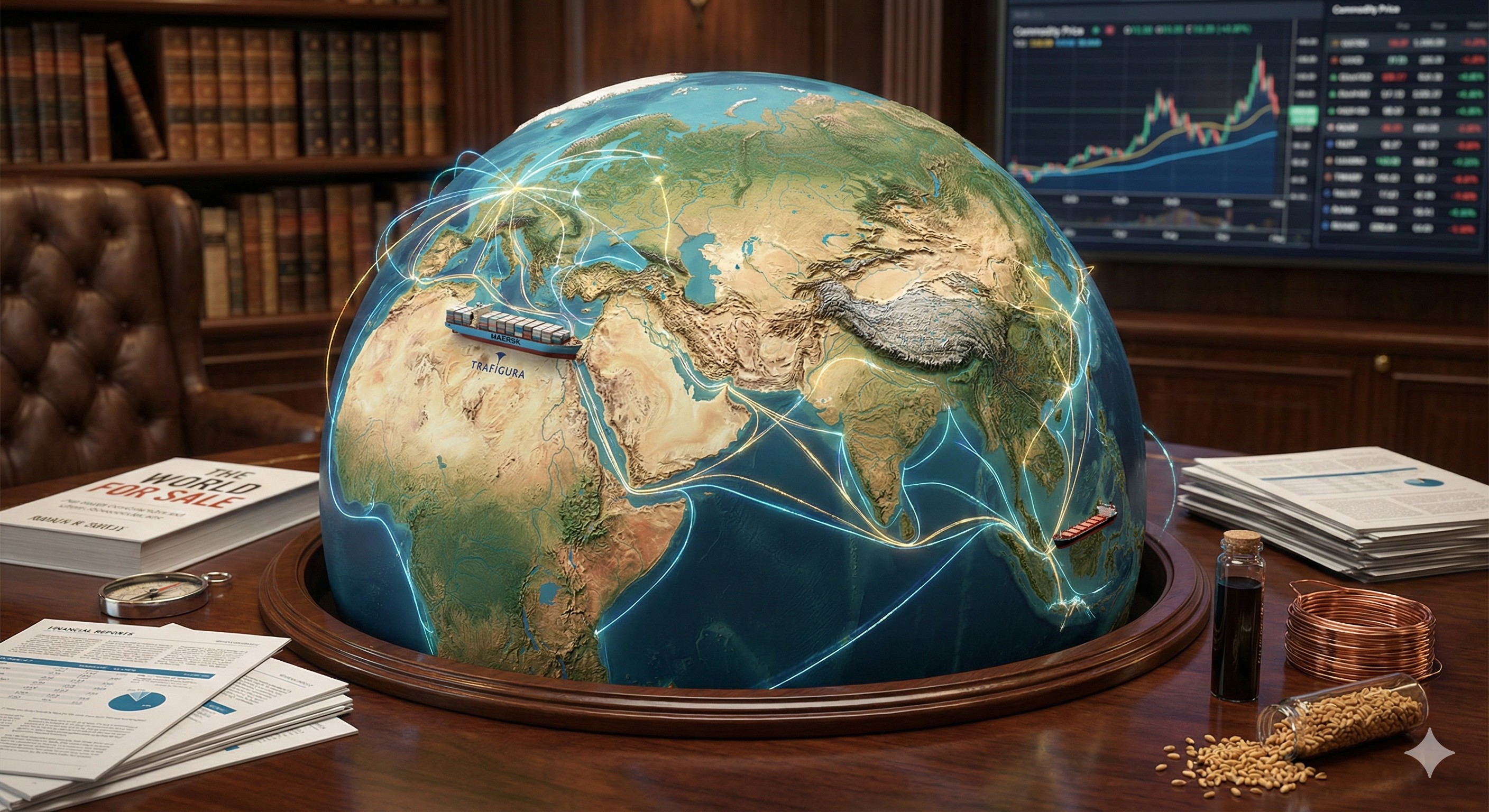
Today's global order is defined by the friction between the physical earth and the flow of money. While geography remains a permanent limit for nations, the movement of resources is fast and flexible. This analysis explores this dynamic by looking at Tim Marshall’s work on geography alongside Javier Blas and Jack Farchy’s reporting on the commodity markets.
The central thesis is that although countries are still bound by mountains and rivers, a parallel power structure has emerged among commodity houses. These traders act as intermediaries who transform physical obstacles and political risks into profit. By synthesizing these two perspectives, the report explains how modern power is no longer the sole property of the state. Rather, it is something managed through the global supply chains of food, energy, and minerals.
I. Introduction: The Dialectic of Rock and Liquid
The study of international relations is often divided into two competing schools: those who look at the map, and those who look at the balance sheet. The former, exemplified by Tim Marshall’s Prisoners of Geography, argues that the physical world, the location of mountains, the depth of harbors, the flow of rivers, imposes a "geographic determinism" on the destiny of nations that no ideology or technology can fully overcome.[1] The latter, illuminated by Javier Blas and Jack Farchy in The World for Sale, reveals a hidden layer of global power: the commodity traders who move the raw materials of civilization across borders, often defying the constraints of politics and geography through financial alchemy and logistical daring.[3]
This report explores the interaction between these two realities. It posits that the world is best understood not as a static board of risk, but as a dynamic system of "flows" governed by the laws of supply chain physics and the gravity models of trade.[5] In this system, geography provides the resistance (friction), while commodity traders provide the energy (capital and logistics) to overcome it. From the frozen ports of Russia to the pirate-infested waters of the Malacca Strait, and from the boardrooms of Geneva to the battlefields of Libya, we analyze how the physical world shapes power and how the financial world attempts to buy it.
II. The Prison of the Map: Geographic Determinism in Statecraft
To understand the machinations of global trade, one must first accept the stage upon which it is set. Tim Marshall’s work posits that the political choices of leaders are severely constrained by the physical reality of their territory. Geography does not merely influence human events; it often dictates them, creating a framework of necessity that has shaped empires for millennia.[7]
2.1 Russia: The Anxiety of the North European Plain
The Russian Federation, despite its immense size, is defined by a fundamental insecurity rooted in its topography. The core of the Russian state, west of the Urals, sits at the terminus of the North European Plain (or Great European Plain). This vast, flat corridor stretches from France to Moscow, narrowing as it moves east but offering no significant natural barriers to invasion.[2]
The Vulnerability of the Flatlands
This geographical feature has served as a highway for invaders, from Napoleon’s Grande Armée to Hitler’s Wehrmacht, forcing Russian leadership into a perpetual strategy of creating "buffer zones" to the west.[2] Marshall argues that this "imprisons" Russian leaders; regardless of whether the Tsar, the General Secretary, or the President sits in the Kremlin, the view to the west remains the same: a flat, indefensible horizon.[9] This necessitates a strategic depth that requires political control over the flatlands of Ukraine and Belarus. The invasion of Ukraine, therefore, can be analyzed not just as an ideological reclamation but as a geographic imperative to plug the gap in Russia’s natural defenses.[2]
The Warm-Water Port Obsession
Beyond the plains, Russia is defined by its relationship with the sea, or rather, its lack of access to it. Despite possessing one of the longest coastlines in the world, Russia lacks reliable warm-water ports that grant unrestricted access to major global sea lanes.[9]
- Murmansk: Located in the Arctic, it is ice-free year-round due to the Gulf Stream but is geographically isolated from major trade routes and requires navigation through the GIUK gap (Greenland-Iceland-UK), a choke point monitored by NATO.[9]
- Vladivostok: The primary Pacific port, yet it freezes for approximately four months of the year, requiring icebreakers to maintain operations. Furthermore, the exit from Vladivostok is enclosed by the Sea of Japan, which is dominated by U.S. allies (Japan and South Korea).[9]
- St. Petersburg: Offers access to the Baltic Sea, but this is a bottleneck controlled by NATO members (Denmark, Norway, the Baltic states), rendering it vulnerable to blockade in times of conflict.[9]
This necessity explains the historical and contemporary obsession with the Black Sea. Sevastopol in Crimea is Russia’s only true warm-water port capable of projecting power into the Mediterranean year-round. However, even this access is constrained by the Turkish Straits (the Bosphorus and Dardanelles), controlled by Turkey, a NATO member.[9] The annexation of Crimea in 2014 was, in this light, a geopolitical imperative to secure the only viable naval exit to the south.[9]
2.2 China: The Island Chains and the Trap of the Heartland
China’s geography presents a different but equally potent set of constraints. Historically a land power, China’s heartland in the North China Plain is fertile and defensible but has fostered an inward-looking civilization.[9] The immense population density of this region is sustained by the Yellow and Yangtze rivers, but the country is ringed by formidable barriers: the Gobi Desert to the north, the Himalayas to the west, and jungles to the south.[2]
The First Island Chain
As China ascended to global economic superpower status, its strategic gaze turned to the sea, where it found itself "imprisoned" by the First Island Chain, a string of archipelagos stretching from Japan to the Philippines and Indonesia.[8] These islands are largely controlled by U.S. allies, effectively blocking China’s direct access to the deeper Pacific Ocean.[8] In a conflict scenario, the U.S. Navy could effectively blockade China within its coastal seas, strangling its economy. This geographic encirclement drives Beijing’s aggressive territorial claims in the South China Sea, where it builds artificial islands to create "unsinkable aircraft carriers" and push its defensive perimeter outward.[8]
The Malacca Dilemma
China faces a critical vulnerability known as the "Malacca Dilemma." A staggering percentage of its energy imports (oil from the Middle East and Africa) and manufactured exports must pass through the Strait of Malacca, a narrow chokepoint between Malaysia, Singapore, and Indonesia.[9] This strait is easily blockaded. This vulnerability drives China’s massive infrastructure investments, such as the Belt and Road Initiative (BRI). The BRI is not solely an economic development project; it is a geostrategic effort to build overland corridors that bypass maritime chokepoints.[11]
- The China-Pakistan Economic Corridor (CPEC): This flagship project connects western China (Xinjiang) directly to the Indian Ocean via the port of Gwadar in Pakistan.[9] This creates a "back door" for energy supplies, bypassing the Malacca Strait entirely and reducing the "distance" variable in the gravity model of trade.[13]
- The Tibetan Plateau: Control over Tibet is not just about territory but hydrology. Tibet is the "Water Tower of Asia," the source of the Yellow, Yangtze, Mekong, Brahmaputra, and Indus rivers.[10] By controlling Tibet, China controls the water security of India and Southeast Asia, giving it immense leverage over its neighbors.[10]
2.3 The American Exception: Geography as Destiny
In stark contrast to Russia and China, the United States is arguably the most geographically fortunate great power in history. It controls the temperate center of the North American continent, flanked by two vast oceans (the Atlantic and Pacific) that protect it from invasion while granting access to the world's two major trading basins.[8]
Internally, the U.S. possesses the Greater Mississippi Basin, a river network with more navigable miles than the rest of the world combined.[9] This natural transport network allows for the cheap, efficient movement of agricultural and industrial goods from the heartland to the global market. The cost of transporting goods by water is a fraction of the cost by land; this "geographic endowment" allowed for internal capital accumulation that underpinned America's rise to superpower status.[9] While other nations struggle to overcome their geography (Russia fighting the ice, China fighting the mountains), the United States’ geography actively facilitates its economic dominance.
III. The Physics of Supply Chains: Theoretical Underpinnings of Global Trade
To deeply understand how traders and geography interact, we must move beyond descriptive geopolitics and look to the theoretical frameworks of "supply chain physics" and the "gravity model of trade." These concepts provide the scientific basis for understanding why trade flows the way it does and how disruptions propagate through the system.
3.1 The Gravity Model of Trade
In international economics, the Gravity Model of Trade acts as the governing equation of globalization. Derived from Newton’s Law of Universal Gravitation, it predicts that the volume of trade between two countries is proportional to their economic mass (GDP) and inversely proportional to the distance between them.[5]
The foundational equation is expressed as:
`F_ij = G (M_i M_j) / D_ij`
- F_ij is the trade flow between country i and country j.
- M represents the economic mass (GDP) of the countries.
- D represents the distance (or friction) between them.
- G is a constant representing variable factors like cultural affinity or trade agreements.
Geography creates the initial, immutable value of D (distance). Physical barriers like the Himalayas or the Atlantic Ocean increase this friction.[16] However, the primary role of the commodity trader and the logistics industry is to artificially reduce D through efficiency, infrastructure, and financial instruments.[17] When a trader utilizes a supertanker to move oil more cheaply, or when the Panama Canal is widened, the effective economic distance between nations collapses. Conversely, geopolitical barriers (tariffs, sanctions, war) serve to artificially increase D, reducing trade flows even if the physical distance remains unchanged.[18]
Academic critiques of geographic determinism argue that distance is not the sole factor; institutions, technology, and policy can overcome geographic disadvantages.[14] However, empirical evidence consistently shows that physical proximity and access to coasts remain powerful predictors of economic integration. Landlocked developing countries, for instance, face exponentially higher transport costs, a "geographic tax" that hampers growth.[14]
3.2 Fluid Dynamics and the Flow of Trade
A powerful metaphor increasingly used in econophysics is fluid dynamics. Trade flows like a fluid, moving from areas of high pressure (surplus supply) to low pressure (excess demand) along the path of least resistance.[20] This flow is governed by "valves" (choke points) and "pipes" (shipping lanes).
- Laminar Flow vs. Turbulent Flow: Ideally, global trade exhibits laminar flow—smooth, efficient, and predictable movement of goods. However, geopolitical shocks (wars, sanctions) or physical disruptions (droughts, blockades) introduce turbulence.[6]
- The Bullwhip Effect: Just as fluid waves amplify, small disruptions at one end of a supply chain can cause massive volatility upstream. This is known in logistics as the "bullwhip effect".[23]
- Viscosity: Trade "viscosity" refers to the resistance within the market—regulatory hurdles, tariffs, or lack of financing. Commodity traders act as "lubricants," reducing this viscosity to ensure the fluid keeps moving.[6]
The commodity trading houses described in The World for Sale are masters of this fluid dynamic. They profit from turbulence. When a market is calm (laminar), margins are thin. When a market is disrupted (turbulent)—for example, when Libyan oil is taken offline or a pipeline is blown up—price differentials widen, and the arbitrage opportunities become enormous.[3] They manage the storage tanks (capacitors) that buffer these fluctuations, buying cheap when the flow is high and selling dear when the flow is restricted.[25]
IV. The Merchants of Power: Arbitrage in the Shadows
If geography constitutes the "hardware" of the global order, the commodity traders described in The World for Sale represent the "software" that allows the system to function. Blas and Farchy unveil a class of actors, companies like Glencore, Vitol, Trafigura, Cargill, and Mercuria, who operate in the interstices of the global economy. They profit from the friction between supply and demand, and between political instability and market necessity.[3]
4.1 The Function of the Trader: Trafigura's "Commodities Demystified"
While critics often view traders as speculators, the industry defines its own role through the lens of logistics and transformation. As outlined in Trafigura’s Commodities Demystified guide (2018) and economic analyses by Craig Pirrong, commodity traders perform three fundamental transformations that convert raw materials into economic value. These functions effectively "smooth" the friction caused by the world’s unequal geography.[26]
- Transformation in Space (Logistics): This is the conquest of distance (D in the gravity model). Natural resources are rarely located where they are consumed. Traders bridge this gap by moving oil from the deserts of the Middle East to the factories of China, or copper from the Andes to the ports of Europe. They manage the complex logistics of shipping, pipelines, and rail to arbitrage the price difference between location A and location B.[4]
- Transformation in Time (Storage): Production and consumption rarely align perfectly. Traders smooth this volatility by storing commodities when demand is low (contango markets) and releasing them when demand spikes (backwardation). By acting as the "storage tanks" of the global economy, they prevent physical shortages during crises and absorb excess supply during gluts.[25]
- Transformation in Form (Processing): Raw materials often require alteration to be useful. Traders blend different grades of crude oil to meet specific refinery requirements or process concentrates into metals. This technical arbitrage allows them to match a heterogeneous supply with specific industrial demands.[25]
Through these three transformations, traders argue they provide a vital service: they resolve the "mismatch between supply and demand" inherent in the earth's geography.[26] However, as The World for Sale argues, this service often grants them the power to stabilize—or destabilize—entire nations.[4]
4.2 The Privatization of Geopolitics: Financing the State
One of the most profound insights from The World for Sale is the revelation that commodity traders have effectively become lenders of last resort for fragile states. When traditional banks and multilateral institutions (like the IMF) retreat due to sanctions, reputational risk, or instability, traders step in with "pre-finance" (PXF) deals, advancing cash in exchange for future delivery of physical commodities.[3]
Case Study: The Kurdish Oil Gamble
The relationship between Glencore, Vitol, and the Kurdistan Regional Government (KRG) in Iraq exemplifies this dynamic. In the chaos following the Iraq War and the rise of ISIS, the semi-autonomous Kurdish region sought economic independence from Baghdad. However, they lacked the cash to pay their peshmerga forces and civil servants, and Baghdad had cut their budget allocation.[28]
Commodity traders, including Glencore and Vitol, stepped in to fill this void. They provided billions of dollars in pre-finance loans to the KRG, effectively banking on the region's future oil production.[4] This was not merely a commercial transaction; it was a geopolitical intervention.
- The Mechanism: The traders advanced cash (often hundreds of millions at a time) to the KRG. In return, the KRG assigned future barrels of oil to the traders. The oil was piped to the Turkish port of Ceyhan, lifted by the traders onto tankers, and sold into the international market (often to Israel or European refineries).[29]
- The Impact: By providing independent revenue streams, the traders emboldened the KRG’s push for independence, allowing them to bypass the central government in Baghdad which technically claimed ownership of the oil.[28] The traders, motivated by profit and arbitrage opportunities, effectively functioned as a central bank for a proto-state, demonstrating how financial flows can alter the political map.[4]
Case Study: Fueling the Libyan Revolution
During the 2011 Libyan civil war, the rebels in Benghazi faced a critical geographic and logistical paradox: they sat on vast oil reserves but lacked the refining capacity to turn that crude into the gasoline and diesel needed to power their tanks and technicals. They were rich in crude but energy-starved.[24]
Enter Ian Taylor, the legendary CEO of Vitol. In a high-risk deal sealed with a handshake in a Benghazi hotel, Taylor agreed to supply the rebels with $1 billion worth of refined fuel, to be paid back after they won the war.[24]
- The Risk: If Gaddafi had won, Vitol would have lost $1 billion and likely faced legal action.
- The Logistics: Vitol navigated the NATO blockade and the risks of sea mines to deliver tankers of diesel to rebel-held ports.
- The Outcome: This transaction was pivotal. Without this fuel, the rebellion likely would have stalled. Vitol’s ability to navigate the logistics of a war zone acted as a force multiplier superior to many diplomatic interventions.[24] The trader assumed a risk that sovereign states were unwilling to take, and in doing so, reshaped the political geography of North Africa.
4.3 The Mechanism of Corruption: "Suitcases of Cash"
The operational flexibility of commodity traders often brings them into the grey zones of international law. The industry has a history of engaging with unsavory regimes and employing questionable methods to secure deals. The World for Sale details the "buccaneering" culture born in the days of Marc Rich, the fugitive trader who founded the company that became Glencore.[3]
The book details instances of bribery and corruption that grease the wheels of these flows. In Kazakhstan, Iraq, and across Africa, traders have been accused of using intermediaries to pay bribes, sometimes literally "suitcases full of cash," to government officials to secure oil allocations or favorable terms.[33] This corruption is often rationalized as the "cost of doing business" in frontier markets. While the industry has attempted to professionalize, and public listings (like Glencore’s IPO) have brought more scrutiny, the fundamental business model relies on information asymmetry and the willingness to operate where others will not.[3] This willingness to engage with pariah states, from Apartheid South Africa to Castro’s Cuba and Putin’s Russia, highlights the traders' amoral stance: the map is not a territory of friends and enemies, but of buyers and sellers.[29]
4.4 The Cost of Flow: The Trafigura Toxic Waste Scandal
The pursuit of arbitrage often comes with severe externalities. One of the darkest chapters in the history of commodity trading is the 2006 Trafigura toxic waste scandal. Trafigura had a cargo of "coker gasoline" (a low-quality by-product) that required "washing" with caustic soda to remove sulfur, a chemical transformation to increase value.[36]
However, the process created a highly toxic residue. Rather than paying a high fee to dispose of this waste properly in Europe, the waste was transported to Abidjan, Côte d'Ivoire, aboard the vessel Probo Koala. It was dumped at open-air sites around the city by a local contractor.[37]
- The Consequences: The toxic fumes sickened over 100,000 people and were linked to several deaths.
- The Geography of Waste: This incident highlights how traders arbitrage regulatory geography, moving waste from the highly regulated North (Europe) to the loosely regulated South (Africa) to save costs. It is a stark reminder of the physical, human cost of financial flow optimization.[37]
V. When Geography Strikes Back: Choke Points and Modern Crises
The interaction between the static map (Marshall) and the dynamic market (Blas/Farchy) is most visible at the world's strategic choke points. These are the locations where the "fluid" of global trade is forced through narrow geographic constrictions, creating vulnerabilities that no amount of financial engineering can fully mitigate.
5.1 The Red Sea and the Suez Canal: The Arteries of Empire
The Suez Canal and the Bab el-Mandeb Strait connect Europe to Asia, facilitating approximately 12% of global trade.[39] This route is a legacy of the 19th-century drive to shorten the distance between the metropole and the colonies.
The Houthi attacks in the Red Sea (2023-2024) demonstrated the extreme fragility of this route. When this "valve" was threatened by asymmetric warfare (drones and missiles), the "fluid" of trade was forced to reroute around the Cape of Good Hope, a geographic regression to the pre-Suez era.[40]
- Quantifying the Disruption: This rerouting added roughly 3,500 nautical miles and 10-14 days to a typical Asia-Europe voyage.[39]
- The Physics of Cost: This increase in D (distance) dramatically increased freight rates, fuel consumption, and insurance premiums. It also imposed a carbon cost, with emissions rising significantly per voyage.[41]
- The Insight: It demonstrated that despite modern technology, trade is still physically bound to the shape of the continents. The "Prisoners of Geography" thesis is vindicated here: control over these narrow waterways remains a primary determinant of global stability.[42]
5.2 The Panama Canal: Climate as the New Geography
While the Red Sea crisis was geopolitical, the crisis at the Panama Canal was strictly environmental, illustrating how climate change is rewriting the map. The Panama Canal relies on fresh water from Gatun Lake to operate its locks. A severe drought in 2023-2024, exacerbated by El Niño, lowered water levels to critical lows.[27]
This physical constraint forced the Canal Authority to drastically reduce the number of daily transits from an average of 36 to roughly 18-24, and to reduce the allowable draft of ships.[44]
- Impact on Tonnage: In FY2024, cargo tonnage through the canal dropped to 423 million tons, a significant contraction.[46]
- Trade Divergence: This created a physical bottleneck for US LNG exports (typically moving from the Gulf Coast to Asia) and agricultural products. Traders were forced to bid millions of dollars in auctions just to skip the line, or reroute ships through the Suez Canal (before the Red Sea crisis) or around Cape Horn.[47]
- Implication: This is a profound example of dynamic geography. The map is not static; the capacity of trade routes is fluctuating with the climate.
5.3 The Energy Pivot: LNG vs. Pipelines
The war in Ukraine highlighted the tension between fixed infrastructure and flexible trade. Europe was historically dependent on fixed pipelines from Russia (Nord Stream, Druzhba), a geographic tether that physically bound its economy to Moscow.[2] Pipelines are the ultimate geographic prison; they cannot move.
When this link was severed by sanctions and sabotage, Europe turned to the global market, specifically Liquefied Natural Gas (LNG) from the United States and Qatar.[47]
- Financialization of Geography: LNG represents the liberation of gas from geography. By cooling gas to -162°C, it becomes a liquid that can be shipped anywhere the price is highest. This allowed the US to replace Russia as Europe's energy guarantor.[47]
- The Geographic Tax: However, this flexibility comes at a cost. The process of liquefaction, shipping, and regasification is significantly more expensive than piping gas across the North European Plain.[50] Europe paid a "sovereignty premium" to escape its geographic imprisonment by Russia.
VI. Strategic Corridors: Rewriting the Map
If geography is a prison, infrastructure projects are the escape tunnels. Nations are actively attempting to rewrite their geographic destiny by building new "economic corridors."
6.1 The Belt and Road Initiative (BRI)
China's BRI is the most ambitious attempt in history to reconfigure the geography of trade. It is a direct response to the "Malacca Dilemma" and the encirclement of the Island Chains.
- The Iron Silk Road: By building rail links across Central Asia (the "New Eurasian Land Bridge"), China aims to create an overland route to Europe that bypasses the US Navy's dominance on the high seas.[8]
- CPEC: The China-Pakistan Economic Corridor is the crown jewel. It connects the Chinese province of Xinjiang to the port of Gwadar on the Arabian Sea. This acts as a bypass valve, allowing energy imports to enter China without passing through the Malacca Strait.[9] This fundamentally alters the strategic calculus of the region, turning Pakistan into a vital geographic pivot for Beijing.[13]
6.2 The Middle Corridor
In the wake of the Russia-Ukraine war, the "Middle Corridor" (Trans-Caspian International Transport Route) has gained prominence. Running from China through Kazakhstan, across the Caspian Sea, through Azerbaijan and Georgia, and into Turkey/Europe, it bypasses Russia entirely.[52]
- The Challenge: This route is multimodal and logistically complex (requiring transfers from rail to ship and back to rail). It has high "friction."
- The Necessity: However, political necessity (sanctions on Russia) is forcing capital to overcome these physical frictions. Traders and logistics firms are pouring investment into this route to create a viable alternative to the Northern Corridor through Russia.[52]
VII. Synthesis: The Geopolitical Arbitrage
The synthesis of Prisoners of Geography and The World for Sale provides a nuanced, stereoscopic view of global power. Marshall teaches us that the physical stage is set: Russia will always fear the plain, China will always seek the ocean, and the US will always benefit from its river basins. These are the structural conditions of international relations.
However, Blas and Farchy teach us that these conditions are not absolute. They create differentials—in price, security, and availability. Commodity traders exist to exploit these differentials. They act as the kinetic energy in the system, moving resources across barriers that states cannot easily cross.
- When Russia is sanctioned (political barrier), traders find shadow fleets to move its oil.
- When the Suez Canal is blocked (geographic barrier), traders reroute flows and hedge the price risk.
- When a landlocked region like Kurdistan wants independence, traders provide the capital that the physical geography denies them.
Comparative Thematic Analysis
| Feature | Prisoners of Geography (Marshall) | The World for Sale (Blas & Farchy) |
|---|---|---|
| Primary Driver | Physical features (mountains, rivers, plains). | Financial incentives (price, arbitrage, credit). |
| View of Borders | Rigid lines defining security and identity. | Porous obstacles to be navigated or bribed. |
| Power resides in... | The State and its Military. | The Trader and their Capital. |
| View of Crisis | Inevitable result of clashing geographic interests. | A profit opportunity (volatility). |
| Middle East | Defined by artificial borders ignoring tribal/sectarian lines.[1] | A market for oil exports and arms imports financed by oil.[3] |
VIII. Future Outlook: A New Map?
As we look forward, three trends will define the interaction of geography and trade:
8.1 The Opening of the Arctic
Climate change is melting the ice of the Arctic Ocean, potentially opening the Northern Sea Route for commercial shipping. This would be a geographic revolution, drastically shortening the distance between Europe and Asia and benefiting Russia, which controls the coastline.[8] This would rewrite the gravity model of trade, shifting the center of gravity north and potentially reducing the importance of the Suez Canal/Malacca route.
8.2 The Green Geography
The transition to renewable energy creates a new map of resources. The geography of oil (Middle East, Russia, USA) is being replaced by the geography of critical minerals (lithium in Chile/Australia, Cobalt in Congo, Nickel in Indonesia).[3]
New Choke Points: This shifts power to new regions and creates new "choke points"—not straits, but processing centers. China’s current dominance in refining these minerals (controlling ~70-80% of the supply chain for some) is the new "First Island Chain" encirclement of the West’s industrial base.
8.3 Fragmenting Flows
The era of seamless globalization (facilitated by traders) is ending. We are entering a period of "friend-shoring" and trade blocs, where political alignment may trump geographic efficiency.[53] The "flat world" of the trader is becoming rugged again, as tariffs and sanctions raise the walls between nations.
IX. Conclusion
The world is not flat. It is rugged, mountainous, and divided. But it is also liquid, flowing, and transactional. Understanding global power requires reading the map with one eye and the ticker tape with the other. Prisoners of Geography explains why the game is played; The World for Sale explains how the score is kept.
Geography sets the difficulty level of the game, determining which nations start with advantages and which face existential threats. But the commodity traders prove that with enough capital, risk appetite, and moral flexibility, even the most formidable geographic prisons can be breached, at least for a price. As we move into an era of climate disruption and renewed great power competition, the interplay between the immovable rock of geography and the irresistible flow of trade will define the 21st century.
References
- Prisoners of Geography - Wikipedia
- Are we really prisoners of geography? | World news | The Guardian
- The World for Sale Summary of Key Ideas and Review | Javier Blas, Jack Farchy - Blinkist
- The World for Sale | Summary, Quotes, FAQ, Audio - SoBrief
- Gravity model of trade - Wikipedia
- Social dynamics and stability of human society - Frontiers
- (PDF) Theory of technologies of geographical determinism in international relations
- Prisoners of Geography | Summary, Quotes, FAQ, Audio - SoBrief
- Book Summary: Prisoners of Geography by Tim Marshall - To Summarise
- Notes - Prisoners of Geography (Tim Marshall) - Damian Bogunowicz
- Belt and Road Initiative - Wikipedia
- Global Perspectives on China's Belt and Road Initiative - OAPEN Library
- Belt and Road Economics - World Bank Documents & Reports
- CID Working Paper No. 001 :: Geography and Economic Development by John Luke Gallup and Jeffrey D. Sachs
- An Advanced Guide to Trade Policy Analysis: The Structural Gravity Model, chapter 1 - UNCTAD
- Gravity Model and International Trade: A Survey of the Literature - MDPI
- Gravity in diagrams - International Trade Commission
- Publication: Gravity Model–Based Export Potential: An Application to Turkey - Open Knowledge Repository
- The Geography of Economic Development - U.S. Naval War College Digital Commons
- A state of flow - Duke Corporate Education
- That Great Business Show - Acast
- Marx's Theory of Value at the Frontiers: Classical Political Economics, Imperialism and Ecological Breakdown
- Information Distortion in a Supply Chain: The Bullwhip Effect | Management Science
- The World for Sale: Money, Power, and the Traders Who Barter the Earth's Resources
- Full article: Creating global capitalism: An introduction to commodity trading companies and the first global economy
- Navigating troubled waters Impact to global trade of disruption of shipping routes in the Red Sea, Black Sea and Panama Canal - UNCTAD
- Drought, Climate, and the Panama Canal
- Energy and Environment | Council on Foreign Relations
- The World for Sale: Money, Power and the Traders Who Barter the Earth's Resources by Javier Blas | Goodreads
- Statehood in KRI through an Economic Lens - American University of Iraq, Sulaimani
- The World for Sale - Jellybooks Cloud Reader
- Walking over dead bodies - Lipmann Walton
- The World for Sale: Money, Power and the Traders Who Barter the Earth's Resources by Javier Blas | Goodreads
- Acknowledgements - GovInfo
- Torrential rain troubles quake-stricken Kermanshahis - Tehran Times
- The one-handed economist – Sometimes you just want the answer
- The Waste of the World: Consumption, Economies and the Making of the Global Waste Problem
- TRAFIGURA REACH FOR THE (NYR)STAR - Beleggen.nl
- These Four Chokepoints Are Threatening Global Trade | BCG
- Red Sea Shipping Disruptions & Suez Canal Impacts 2023–2025
- Suez and Panama Canal disruptions threaten global trade and development - UNCTAD
- Choke Point: Great Power Infrastructure Competition in the Red Sea - INSS
- How a Drought in the Panama Canal Is Disrupting Global Supply Chains | Baker Institute
- Navigating troubled waters: Impact to global trade of disruption of shipping routes in the Red Sea, Black Sea and Panama Canal - PreventionWeb
- Navigating troubled waters: Impact to global trade of disruption of shipping routes in the Red Sea, Black Sea and Panama Canal | UNCTAD
- Panama Canal Presents Financial Results for FY24 with a Focus on Sustainability and the Future
- LNG and the Uncharted Future of US-EU Energy Relations | IAI Istituto Affari Internazionali
- U.S. Trade and the Impact of Low Water Levels in Gatun Lake and the Panama Canal
- Europe reengages with energy security - S&P Global
- Déjà vu as EU risks overreliance on one gas supplier - IEEFA
- Mapping China's Himalayan Hustle - Institute for Security & Development Policy
- Highlighting the Geopolitical Challenges Facing the China One Belt One Road Initiative
- Geopolitics and the geometry of global trade - McKinsey