 Phil's Blog
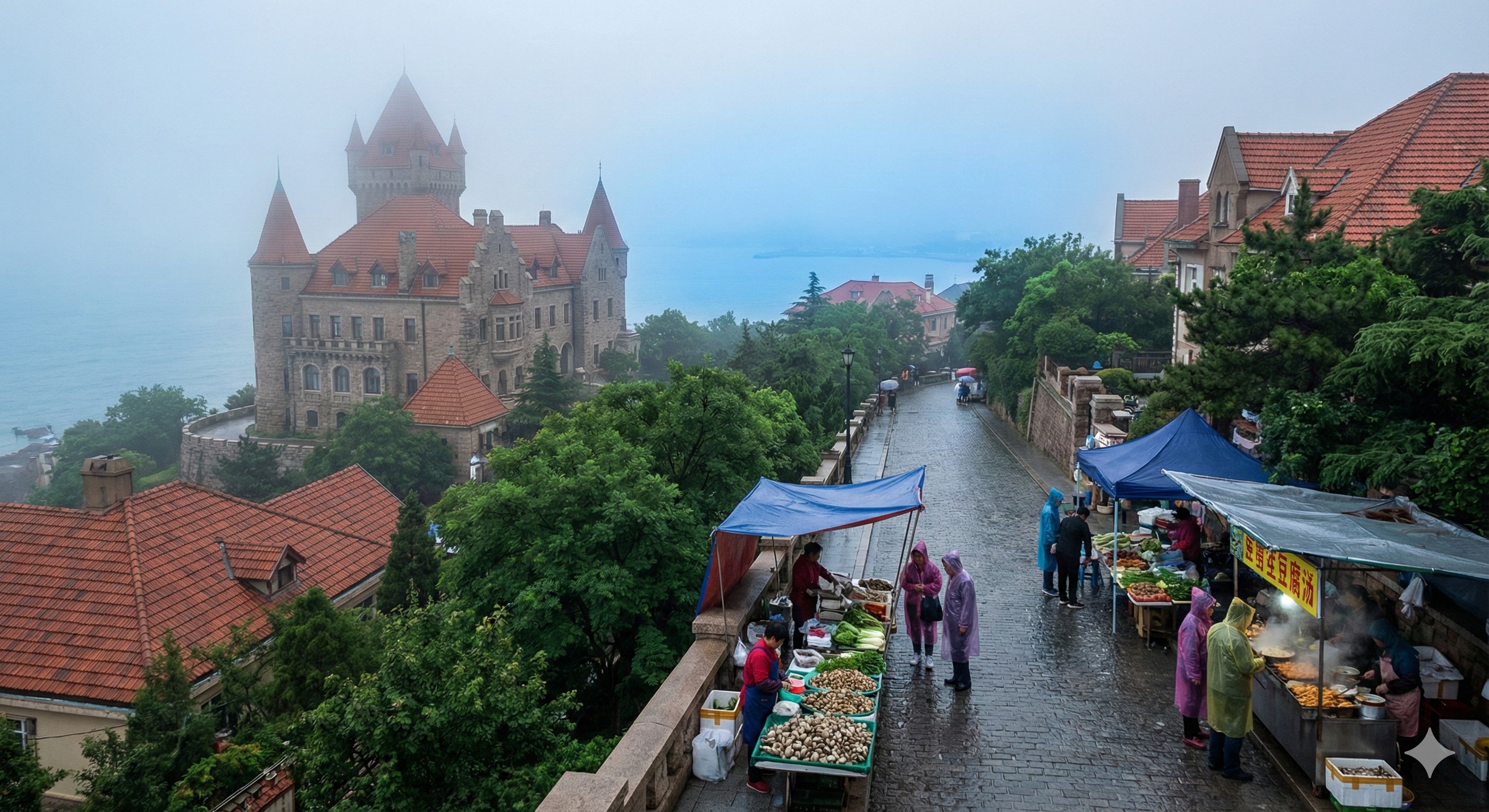
Walk through the hilly streets of Qingdao on a misty morning, and you might briefly forget which continent you are standing on. To your left, a Bavarian-style castle with rough-hewn granite walls overlooks the sea; to your right, locals are buying clams and spicy stir-fries. This is China’s "Island of Youth," a city where the echoes of a seventeen-year German occupation have been absorbed into a modern metropolis of over ten million people. It is a place defined by a unique color palette - red tiles, green trees, and the blue sea - and a distinct rhythm of life that flows as freely as its most famous export, beer.
The city’s origin story is unlike the gradual growth of ancient Chinese capitals. It was born from a specific geopolitical ambition when the German Empire, seeking a naval stronghold in East Asia, seized the fishing village of Tsingtao in 1897. They didn’t just build a fort; they attempted to build a "Model Colony" to showcase German efficiency to the world. They paved roads, laid a sewage network that remains legendary in local urban myths, and constructed buildings like the Governor’s Mansion, a castle that looks as if it were plucked straight from the Black Forest and dropped onto Signal Hill. This building is so opulent that its original construction cost of nearly one million Marks scandalized the imperial parliament in Berlin, yet today it stands as a museum where you can walk on the same floors that once hosted German governors and later Chairman Mao.[1]
But the German legacy isn't just in the skyline; it is buried deep inside the mountains. One of the city’s most fascinating and eerie secrets is the vast network of military tunnels hollowed out beneath Mount Qingdao. The Germans blasted these subterranean passages to create a command post and defensive network that could survive heavy bombardment. Today, visitors can descend into the Mount Qingdao Fort Museum to explore this warren of damp corridors, mess halls, and ammunition stores. It is an atmospheric experience, where you can still see the original revolving turret mechanisms and wander through dimly lit passages that feel frozen in 1914. Just a short distance away, another civil defense tunnel has been creatively repurposed into the Qingdao Wine Museum, housing thousands of wine bottles in a space once designed for war.
While the architecture sets the scene, beer provides the soundtrack to daily life here. The Anglo-German Brewery Co. Ltd. was founded in 1903 to ensure German soldiers and sailors had a taste of home, but the locals embraced it with a fervor that outlasted the colony. You haven't truly experienced Qingdao until you've bought beer in a plastic bag. This isn't a gimmick for tourists; it is the standard way residents purchase fresh, unpasteurized draft beer, known as shengpi, from street kegs. It is sold by weight - usually per jin (500g) - and drunk through a straw while walking down the street or paired with a meal of spicy clams.
Connoisseurs on the street will tell you that not all bags are created equal. You can choose from a variety of brews that rarely make it out of the city, such as the standard "Raw" beer with a shelf life of only 24 hours, a dark and malty Stout that tastes of burnt caramel, or the premium Augerta 1903, which uses special German yeast and Czech hops for a richer profile. This obsession culminates every August in the Qingdao International Beer Festival, a bacchanalian event that rivals Munich’s Oktoberfest, attracting over six million visitors who consume thousands of tons of beer in a single month.[10]
Beyond the romance of old villas and fresh lager, Qingdao is an industrial titan. The same natural advantages that attracted Admiral Tirpitz - a deep, silt-free, and ice-free harbor - make the Port of Qingdao one of the busiest in the world today. It handles everything from crude oil to millions of shipping containers without needing constant dredging.[4] This port is the seaward anchor of the Belt and Road Initiative (BRI), acting as a bridgehead where maritime shipping meets the continental rail network. Trains loaded with tires, household appliances, and machinery depart from here, traveling thousands of miles overland to Central Asia and Europe, effectively reviving the ancient Silk Road with steel rails and high-speed logistics.[12]
The city is also a manufacturing powerhouse, earning it the title of China's "Capital of Brands." It is the home of Haier, the world's largest appliance maker, and Hisense, a giant in electronics. But perhaps most impressively, it is the birthplace of the trains that bind China together. CRRC Qingdao Sifang, which traces its roots back to a German locomotive works from 1900, now builds the majority of China’s high-speed trains. This factory is pushing the boundaries of physics with new maglev technology capable of speeds up to 600 kilometers per hour, blurring the line between rail travel and flying.[6]
Despite this heavy industry, Qingdao retains a reputation as one of China’s most livable cities. The air is cleaner than in the industrial north, and the pace is gentler. The local dialect even keeps the history alive with unique loanwords found nowhere else in China. A manhole cover here is called a Guli (from the German Gully), and a spirited young woman might be referred to as a Daman (from the German Dame), linguistic fossils that have survived for over a century.[8]
Qingdao is a city of layers, where a tourist can emerge from a 19th-century underground bunker to see a 21st-century high-speed train whizzing past, all while sipping the freshest beer in Asia from a plastic bag. It is a place that has taken a complex, colonial past and fermented it into a distinct, confident, and intoxicating modern identity.
References
- THE VISIBLE AND THE INVISIBLE: - Segregation and Communication between the Colonizers and the Locals in the German Water Policy in Qingdao Concession Area, 1898-19141 Introduction - Cornell eCommons
- Mapping colonial space: The planning and building of qingdao by German colonial authorities, 1897-1914 - ResearchGate
- Former Site of German Governor's Residence - Funes
- Introduction to the Port of Qingdao - China Daily
- Top 10 Ports in China: Rankings, Features & FAQs - OUCO Industry
- Unlocking Chinese Cities: Cradle of high-speed trains propels China Brand go global
- High-speed rail in China - Wikipedia
- On Etymology of the Appellation “Da man-er” (大嫚儿) in Qingdao Dialect - David Publishing
- Germanism (linguistics) - Wikipedia)
- Qingdao beer festival a global success - Chinadaily.com.cn
- China Movie Metropolis
- Shandong ports, important nodes witnessing BRI growth, open logistic corridor