 Phil's Blog
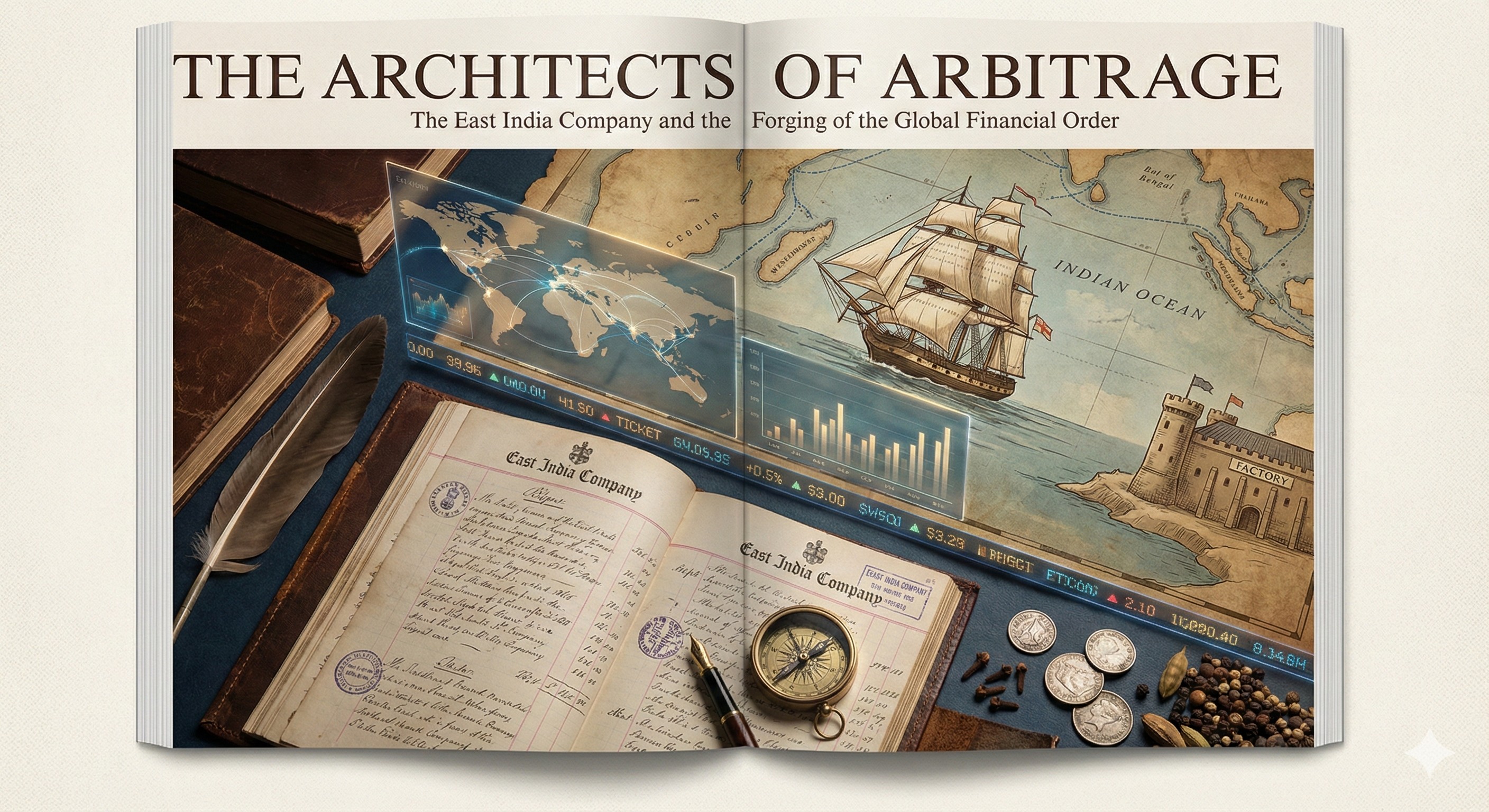
The English East India Company was not just a merchant enterprise or a tool of empire. It was the precursor to our current global economic system. If we want to understand the modern world of credit and logistics, we have to study the breakthroughs and disasters of the EIC. When Queen Elizabeth I chartered the company in 1600, she launched a radical experiment. The organization was designed to manage the immense risks of ocean travel and the difficulty of doing business in distant markets where information moved slowly.
By solving these issues, the EIC created the framework for the global corporations we see today. This report analyzes how the company shaped international trade through its daily operations. It looks at the development of "factories," the use of bills of exchange, and the moment the company moved from trading goods to extracting revenue from land. This history shows how a group of merchant adventurers became a sovereign power. Their struggle with corruption and private trade forced the creation of the rigorous accounting and legal standards that still support our interconnected markets.
2. The Genesis of the Joint-Stock Monopoly: Capital, Risk, and the Charter
2.1 The Challenge of the Cape Route
At the dawn of the 17th century, the global spice trade was dominated by the Iberian powers. Spain and Portugal, united under the Spanish Crown from 1580 to 1640, enforced a rigid monopoly on the route around the Cape of Good Hope. The defeat of the Spanish Armada in 1588 by the English navy shattered the aura of Iberian invincibility and opened the door for English merchants to venture East.[3] However, the logistical and financial barriers were formidable. A single voyage to the "East Indies" (a term encompassing the Indian subcontinent and Southeast Asia) could take up to three years. The risks of shipwreck, piracy, scurvy, and tropical disease meant that any single ship had a high probability of total loss.
Traditional trade structures, such as the "regulated company" (essentially a guild where members traded on their own individual capital), were ill-suited for this environment. No single merchant could bear the risk of fitting out a fleet for a multi-year voyage with uncertain returns. The solution was the Joint-Stock Company. Unlike its predecessors, the EIC pooled capital from a broad base of investors who purchased shares in the venture. This structure allowed for the aggregation of the massive sums required—nearly £70,000 for the first voyage—while distributing the risk across a wide body of shareholders.[3]
2.2 The Legal Architecture of Monopoly
The Royal Charter of 1600 granted the Company a monopoly on English trade with all countries east of the Cape of Good Hope and west of the Straits of Magellan. This legal privilege was not merely a commercial advantage; it was a necessity for survival. The Company had to bear the costs of diplomacy, fortification, and armed defense—costs that "interlopers" (private traders operating outside the Company) would not pay. This "free rider" problem was the primary justification for the monopoly: without exclusive rights to the profits, the Company could not afford the infrastructure of trade.[4]
The Company’s motto, Auspicio Regis et Senatus Angliae ("By command of the King and Parliament of England"), reflected its dual nature.[1] It was a private enterprise driven by profit, yet it acted as an arm of the English state, empowered to wage war, mint coin, and administer justice in its settlements. This fusion of public sovereignty and private profit would become the defining characteristic of the EIC, leading eventually to its dominance over the Indian subcontinent and its complex relationship with the British Parliament.
3. The Factory System: The Human Infrastructure of Early Globalization
3.1 The Factory as a Commercial Node
To manage trade across thousands of miles, the EIC established a network of "factories." These were not manufacturing plants, but fortified warehouses and administrative hubs where "factors" (commercial agents) resided. The factory system was the solution to the seasonality of the Indian Ocean trade. Ships relied on the monsoon winds; they could not arrive and depart at will. Factors remained in-country year-round to aggregate goods—textiles, indigo, saltpetre, and spices—ensuring a full cargo was ready when the fleet arrived.[5]
The first permanent factory was established in Surat in 1613, following a firman (royal decree) from the Mughal Emperor Jahangir.[3] From this foothold, the network expanded to Madras (1639), Bombay (1668), and Calcutta (1690). These settlements were the nodes of early globalization, connecting the weavers of Bengal and the spice farmers of the Moluccas with the consumers of London and Amsterdam.
3.2 The Sociology of the Factory: The Plight of the Writer
The human element of this system is often overlooked in macroeconomic histories, yet it was the friction within the factory system that drove many institutional changes. The Company’s hierarchy was rigid: Writer, Factor, Junior Merchant, Senior Merchant.
The entry-level "Writer" was typically a young man from a gentry family, sent to India to make his fortune. However, the official remuneration was pitifully low. William Farmer, a writer in Bombay in 1763, wrote despairingly of his situation:
"Our allowance of 30 rupees a month [£3.10] really not enough for subsistence. There never was anyone ever so parsimonious that could make it serve".[7]
Farmer noted that despite letters of recommendation, he received little help from his superiors ("The Governour indeed is a very particular man, he has been a Drudge to the Services all his lifetime"). This structural underpayment was a deliberate feature, not a bug, of the EIC system. The Directors in London knew the salaries were insufficient; they expected their servants to supplement their income through "private trade".[8]
3.3 The Agency Problem and Social Disorder
The distance between London and the factories (6-8 months by sail) created a severe Principal-Agent problem. The Directors (Principals) could not effectively monitor the Factors (Agents). This led to rampant "malfeasance" where Company employees traded on their own accounts, often prioritizing their private profits over the Company’s interests.[5]
The social discipline in these distant outposts was also a constant concern. In 1617, the Surat factory was scandalized by the behavior of William Lesk, a preacher sent by the Company to provide moral leadership. Instead of tending to souls, Lesk engaged in "riotous living," drunkenness, and "sexual incontinence".[9] The factors, unable to control him, sent him back to England with a dossier of his misdeeds. However, upon returning to London, Lesk used the "politics of publicity" to slander the factors, illustrating the difficulty the Company faced in managing its reputation and personnel across such vast distances.
To combat this disorder, the Company attempted to impose strict codes of conduct. In 1679, the Agent for the Coast of Coromandel issued orders to "prevent Disorders," banning swearing, drunkenness, and staying out late.[6] These attempts at micromanagement were largely futile, as the structural incentives—low pay and high opportunity for graft—drove the culture of the factories.
Table 1: The EIC Corporate Hierarchy and Remuneration Structure (c. 1750)
| Rank | Annual Salary (approx.) | Primary Duty | Implied Income Source |
|---|---|---|---|
| Writer | £10 - £20 | Copying letters, ledgers, and duplicates. | Private trade (small scale), gambling. |
| Factor | £20 - £40 | Managing warehouse stock, negotiating with brokers. | Private trade (medium scale), commissions. |
| Junior Merchant | £40 - £50 | Independent trading missions, sub-management. | Private trade, lending to locals. |
| Senior Merchant | £60 - £100 | Council membership, strategic decisions. | Large-scale private trade, tax farming. |
| Governor | £200 - £500 | Administration, military command, diplomacy. | Political graft, selling appointments, large scale trade. |
4. The Mechanics of Trade Finance: Bills of Exchange and Indigenous Credit
4.1 The Liquidity Constraint
The primary constraint on EIC trade was liquidity. European goods (woolens, broadcloth) were ill-suited for the tropical climate and had little demand in Asia. Consequently, the Company had to export bullion (silver and gold) to pay for its purchases. This "drain of bullion" was politically sensitive in England, where mercantilist economic theory held that a nation's wealth was defined by its stock of precious metals.
To mitigate the need for physical cash shipment—which was dangerous and expensive—the Company relied on the Bill of Exchange. This instrument, a precursor to the modern check, was an order written by one party (the drawer) instructing another (the drawee) to pay a fixed sum to a third party (the payee) at a future date.[10]
4.2 The Anatomy of an EIC Bill
A typical transaction might look like this: A Company servant in Bengal, having made a profit from private trade, wanted to send his money home to retire in England. He would deposit his silver rupees into the Company’s treasury in Calcutta. In return, the Council in Calcutta would issue him a Bill of Exchange drawn on the Court of Directors in London. The servant would send this bill to his agent in London. After a set period (usually 90 days or more after "sight," i.e., presentation), the Directors in London would pay the agent in Sterling.[8]
This system served two purposes:
- Remittance: It allowed employees to repatriate their wealth safely.
- Finance: It provided the Company in India with immediate cash (rupees) to buy textiles, without waiting for silver ships from London.
To protect against the frequent loss of ships, bills were drawn in "sets" of three or four, known as the "First," "Second," and "Third" of exchange. The payment condition would read: "Pay this my first bill of exchange (second and third of the same tenor and date being unpaid)".[11] This redundancy ensured that if one copy was lost in a shipwreck, the others could still be presented for payment.
4.3 Indigenous Finance: The Hundi and the Banyan
The EIC did not operate in a financial vacuum. India possessed a highly sophisticated financial system that predated European arrival by centuries. The core instrument was the Hundi, a negotiable instrument that functioned as both a bill of exchange and a traveler's check.[12]
The Company relied heavily on Banyans—local merchant-bankers—who acted as intermediaries. These men, such as the famous Kantababu (Krishna Kanta Nandy), provided the bridge between the Company and the local economy. Kantababu, who served as the banyan to Warren Hastings, amassed a fortune by investing in land and revenue farming.[13] These indigenous bankers effectively financed the Company’s operations during periods of liquidity shortage, underwriting the very empire that would eventually displace them.
5. The Transformation: From Merchant to Sovereign (1757-1765)
5.1 The Collapse of the Mughal Center
By the mid-18th century, the Mughal Empire was fracturing. Regional governors (Nawabs) were asserting independence, creating a volatile political landscape. The EIC, initially content with fortified warehouses, found itself drawn into these conflicts to protect its trade privileges. The decisive moment came in 1757 at the Battle of Plassey, where Robert Clive, backed by the financing of the Jagat Seth banking house, defeated the Nawab of Bengal, Siraj-ud-Daulah.[14]
5.2 The Diwani and the Revenue State
The true turning point, however, was the Treaty of Allahabad in 1765. The Mughal Emperor Shah Alam II granted the EIC the Diwani of Bengal, Bihar, and Orissa. This title gave the Company the right to collect the territorial revenues (taxes) of the richest provinces in India.[15]
This fundamentally altered the Company’s business model. It was no longer just a trading firm; it was a Department of Revenue. The taxes collected from the Bengal peasantry were now used to purchase the textiles and spices for export. This system, known as the "Investment," meant that the Company was effectively acquiring Indian goods for free—paid for by the taxes of the very people who produced them.[16]
5.3 The "Drain of Wealth"
This structural shift created what Indian economic historians call the "Drain of Wealth." The mechanism was sophisticated:
- Taxation: The EIC collected silver rupees from landowners (zamindars).
- Purchase: The EIC used these rupees to buy goods for export.
- Sale: The goods were sold in London for Sterling.
- Retention: The Sterling proceeds were retained in Britain to pay dividends to shareholders, pensions to retired officials, and debts to the British government.
Crucially, the export surplus of India did not result in an inflow of bullion or capital, as would happen in normal trade. Instead, it was absorbed by these "Home Charges." Economist Utsa Patnaik estimates that between 1765 and 1938, the total drain amounted to approximately $45 trillion in present value.[17] This massive transfer of capital financed Britain's industrial revolution while simultaneously deindustrializing Bengal, as local weavers could not compete with the Company’s monopsony power.
6. Crisis, Corruption, and the Council Bill Scandal
6.1 The "Nabobs" and the Corruption of Politics
The immense wealth flowing from the Diwani created a new class of British oligarchs: the "Nabobs" (a corruption of the Mughal title Nawab). These men returned to England with colossal fortunes, buying country estates and parliamentary seats.
Paul Benfield is the archetype of the corrupt Nabob. A junior engineer in Madras, Benfield became the principal creditor to the Nawab of Arcot, lending money at usurious rates to the local ruler to help him pay his tributes to the Company. Benfield’s influence was so pervasive that he was said to control eight Members of Parliament.[18] Edmund Burke, in his famous parliamentary speeches, pilloried Benfield as a criminal who had subverted the British constitution with Indian gold. James Gillray, the caricaturist, depicted Benfield as "Count Roupee," riding a horse in Hyde Park, a symbol of the alien and corrupting influence of Eastern wealth on British society.[19]
6.2 The Credit Crisis of 1772
Despite the wealth of its servants, the Company itself faced bankruptcy in 1772. The causes were manifold:
- The Famine of 1770: A catastrophic famine in Bengal killed millions, destroying the tax base.[20]
- Military Costs: The Company maintained a standing army of over 260,000 men—twice the size of the British Army—to defend its territories.[1]
- Bill of Exchange Bubble: Company servants, sensing instability, rushed to remit their fortunes home. They paid rupees into the Calcutta treasury and demanded Bills of Exchange on London. The value of these bills surged fivefold in one year, from £296,562 to £1,577,959.[20]
When these bills arrived in London, the Directors did not have the cash to pay them. The Company was "too big to fail." If the EIC defaulted, it would drag down the banking houses of the City of London.
6.3 The Tea Act and the American Revolution
Desperate for liquidity, the EIC turned to the British government for a bailout. The Prime Minister, Lord North, agreed to a loan but imposed strict conditions (the Regulating Act of 1773). Simultaneously, to help the Company raise cash, Parliament passed the Tea Act of 1773. This allowed the EIC to ship its surplus tea directly to the American colonies, bypassing the duties usually paid in London.[21]
The goal was to undercut Dutch smugglers and sell cheap tea to America, generating quick cash to pay off the bills of exchange. However, American colonists interpreted this as a tyrannical imposition of a monopoly and a tax without representation. The direct result was the Boston Tea Party, where EIC tea was dumped into the harbor.[21] Thus, a credit crisis in Bengal, triggered by the corruption of Company servants and a famine, became the spark for the American Revolution.
7. Legal Evolution: The Law Merchant and the Courtroom
7.1 From Custom to Code: The Law Merchant
The explosion of trade disputes involving the EIC forced the English legal system to adapt. Historically, commercial disputes were settled by the "Law Merchant" (Lex Mercatoria), a transnational body of custom used by merchants across Europe. It emphasized speed, equity, and the negotiability of documents over the rigid formalities of the Common Law.[22]
Lord Mansfield, the Chief Justice of the King's Bench (1756–1788), was instrumental in integrating the Law Merchant into English Common Law. He recognized that for global trade to function, legal rules had to be predictable and aligned with commercial reality. In cases involving EIC bills, Mansfield often ruled in favor of "substantial justice" rather than technicalities, ensuring that bills remained negotiable instruments that could be trusted by third parties.[22]
7.2 Case Study: Williams v. Farmer (1840)
The complexity of EIC operations often led to protracted litigation regarding jurisdiction and liability. The case of Williams v. Farmer (1840) illustrates the legal tangles of empire. Major Hay, an EIC officer domiciled in India, drew a bill of exchange while on a temporary visit to the Cape Colony (South Africa). The bill was dishonored, leading to a suit against the endorsers.
The court had to determine whether Major Hay was subject to the laws of the Cape or the laws of India. The judgment hinged on the concept of "animus revertendi" (intention to return). Since Hay intended to return to India, his domicile remained Indian, impacting the validity of the bill's notice of dishonor.[23] Such cases established the legal precedents for cross-border insolvency and the liability of transient officials—issues that remain relevant in modern expatriate law.
7.3 Fraud and the Death Penalty: The Ryland Case
The reliance on paper credit made forgery a capital threat to the trading system. In 1783, William Wynne Ryland, a famous engraver, was accused of forging a bill of exchange for £210 with the intent to defraud the East India Company.[24] Despite his high social status and artistic fame, the threat his crime posed to the credibility of the financial system was deemed existential. Under the "Bloody Code" of 18th-century England, forgery was a capital offense. Ryland was found guilty and hanged at Tyburn. The severity of the punishment underscored the sanctity of the Bill of Exchange: it was not just paper; it was the currency of empire.
8. The Technological Disruption: The Telegraph and the Annihilation of Time
8.1 The End of Information Asymmetry
For the first 250 years of its existence, the EIC operated with an information lag of several months. This delay defined the market: merchants were speculators who held large inventories, gambling that prices would rise before the next ship arrived.
The invention of the telegraph in the mid-19th century destroyed this model. The first transatlantic cable (1866) and the subsequent connection to India via the Red Sea meant that prices in Bombay could be known in London within minutes.[25]
8.2 Market Convergence and the Death of the Speculator
The economic impact was immediate. Economists have documented a dramatic convergence in prices: the price differential for cotton between Liverpool and Bombay dropped from 5-10% to less than 2-3%.[25] The arbitrage window—the ability to profit from price differences—closed.
This shifted the power from the merchant-speculator to the commission agent and the bank. Firms like Brown Brothers & Co. realized that the telegraph made the old model of merchant banking redundant. They could no longer profit from knowing the news before anyone else. Instead, they pivoted to providing foreign exchange services and issuing letters of credit, using the telegraph to lock in rates instantly.[26] This transition marked the move from "Merchant Capitalism," characterized by high risk and high inventory, to "Managerial Capitalism," characterized by high volume, low margins, and rapid turnover.
9. Codification and Legacy: From EIC to the ICC and UCP
9.1 The Need for Standardization
As the EIC’s monopoly was dismantled (trading rights lost in 1813 and 1833), the trade opened up to thousands of smaller private firms.[4] The informal "Law Merchant" was no longer sufficient to govern this chaotic marketplace. Banks needed standardized rules to handle the millions of Letters of Credit (LCs) that replaced the old Company bills.
The disparate national laws created friction. A letter of credit valid in London might be unenforceable in Paris due to differences in civil vs. common law.
9.2 The Birth of the UCP
To solve this, the International Chamber of Commerce (ICC) was founded in 1919. In 1933, it published the first Uniform Customs and Practice for Documentary Credits (UCP).[28] The UCP was the spiritual successor to the EIC’s internal regulations, but applied globally.
Table 2: Evolution of Trade Finance Rules
| Feature | EIC Era (1600-1858) | Modern Era (ICC UCP 600) |
|---|---|---|
| Authority | Company Charter & Law Merchant | International Contractual Rules (UCP) |
| Instrument | Bill of Exchange (Sets of 3) | Documentary Letter of Credit (LC) |
| Verification | Reputation of the Drawer | Strict Compliance of Documents |
| Dispute Resolution | Court of Chancery / King's Bench | Arbitration / DOCDEX |
| Transit Terms | Customary (e.g., "at ship's rail") | Standardized Incoterms (FOB, CIF) |
9.3 Key Principles: Autonomy and Strict Compliance
The UCP codified two principles that were implicit in EIC trade but often litigated:
- The Principle of Autonomy: The credit is separate from the sales contract. If the documents are in order, the bank must pay, even if the goods are defective. This mirrors the EIC’s need for bills to be paid regardless of the underlying success of the voyage.[29]
- Strict Compliance: "Banks deal in documents, not in goods." This rule protects banks from being dragged into commercial disputes, a direct lesson from the endless litigation of the 18th century.[28]
Alongside the UCP, the ICC introduced Incoterms in 1936 to define shipping responsibilities. Terms like CIF (Cost, Insurance, and Freight) and FOB (Free on Board) standardized who paid for the insurance—a critical issue in the EIC era where the loss of a ship could bankrupt a family.[30]
10. Conclusion: The Long Shadow of the Company
The East India Company was dissolved in 1874, its armies absorbed by the British Crown and its stock redeemed.[1] Yet, the architecture it built remains the operating system of global trade. The Bill of Exchange evolved into the modern Letter of Credit; the Factory became the logistics hub; the Factor became the multinational subsidiary manager.
The EIC demonstrated the immense power of the joint-stock corporation to mobilize capital and conquer markets. It also demonstrated the catastrophic risks of unregulated corporate power—corruption, systemic risk, and the exploitation of vulnerable populations. The "Drain of Wealth" from India remains a stark reminder of how financial mechanisms can be weaponized for extraction.[17]
Today, when a trader in Shanghai issues a digital Letter of Credit to a supplier in Hamburg, governed by UCP 600 and insured under Incoterms 2020, they are utilizing a system that was forged in the fire of the EIC’s ambition. The Company is gone, but the Merchant Sovereign lives on in the institutions of global finance.
Appendix A: Statistical Note on the "Drain of Wealth"
- Source: Utsa Patnaik, "Dispossession, Deprivation, and Development" (Columbia University Press).
- Period: 1765 to 1938.
- Mechanism: Transfer of tax revenues to purchase export goods + Council Bills system.
- Estimated Total: £9.2 trillion (in historical prices compounded).
- Present Value: ~$45 trillion.
- Economic Impact: Financed British public debt and industrialization; suppressed Indian consumption and capital formation.
Appendix B: Selected Legal Cases
- Edie v. East India Company (1761): Established that bills of exchange payable to order were negotiable by endorsement, even if the endorsement did not contain the words "to order".[22]
- Williams v. Farmer (1840): Clarified domicile and notice of dishonor for colonial officials.[23]
- Ryland’s Case (1783): Established forgery of commercial bills as a capital crime against the state economy.[24]
References
- East India Company - Wikipedia
- East India Company | History, John Company, Battle of Plassey, Definition, & Facts | Britannica
- How the East India Company became the world's most powerful business
- The East Indian Monopoly and the Transition from Limited Access in England, 1600-1813
- The Structure of English Trade in the East Indies, 1601–1833
- Preventing disorder at the East India Company factories - Adam Matthew Digital
- William Gamul Farmer's career - The East India Company at Home, 1757–1857
- Contract Enforcement in the English East India Company | The Journal of Economic History
- Full article: Governing Over Distance: Delegating Trust and Dealing with Disorder in the Early East India Company Trade
- Bills of exchange and promissory notes | Trade and commodity finance - LexisNexis
- The Project Gutenberg eBook of The Complete English Tradesman, by Daniel Defoe
- India: from loans to credit since 4000 years and the existence banks for 2500 years - India
- 'At the Durbar' in Calcutta (Chapter 4) - Empires of Complaints
- Company rule in India - Wikipedia
- The East India Company and the Politics of Knowledge - Harvard DASH
- How Britain stole $45 trillion from India | Conflict - Al Jazeera
- Britain drained $45 trillion from Indians during 173 years of colonial rule, renowned economist claims | Daily Sabah
- The History of British India, vol. 5 - Online Library of Liberty
- The East India Company at Home, 1757– 1857 - UCL Discovery
- The East India Company crisis of 1772 (Chapter 8) - Revenue and Reform
- What caused the Boston Tea Party? - The East India Company
- Lord Mansfield and Negotiable Instruments - Schulich Law Scholars
- [Cases decided in the Supreme Court of the Cape of Good Hope [1828- 1849] - SAFLII](https://www.saflii.org/za/cases/ZACGHSCRpMenz/1840/15.pdf)
- Forgery, Facsimile, and the Fabrication of Credit: The Case of William Wynne Ryland by Hannibal de Pencier - Grey Room
- The Great Telegraph Breakthrough of 1866 - Federal Reserve Bank of Richmond
- The Telegraph Revolutionizes Merchant Banking - Brown Brothers Harriman
- East India Company and Raj 1785-1858 - UK Parliament
- The first UCP: what survived? - TradeFinance.training
- Documentary Credit Law and Practice in the Global Information Age
- Know Your Incoterms - International Trade Administration
- Incoterms® Rules 2020 - Munich Re